
And why the real answer lies in the systems we’re not rebuilding.
For the first time in decades, two worlds that rarely intersect — macroeconomics and frontier technology — are colliding around the same question:
How will AI reshape economic growth?
Not in theory.
Not in abstract.
But in the real productivity, output, and value creation of a modern economy.
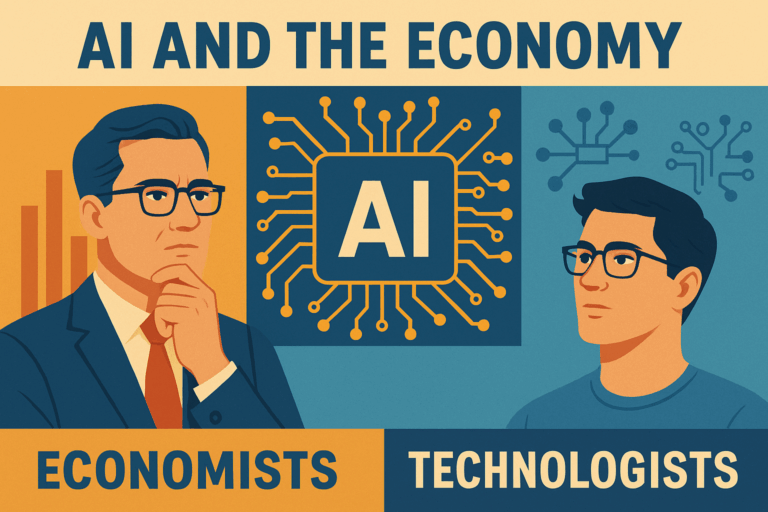
The debate has now split into two camps:
- Economists, who mostly see a moderate long-term effect
- Technologists, who expect exponential transformation
And between these two extremes lies the real story — one that tells us how economies actually change and why AI may be both underestimated and overestimated at the same time.
The Dallas Fed’s Unusual Analysis: Modeling the Unthinkable
A recent report by the Federal Reserve Bank of Dallas attempted something unusual:
predicting AI’s long-term GDP impact.
Their baseline projection was modest:
➡️ +2.1% annual GDP growth for a decade
Not trivial — but far from the “AI-driven economic explosion” many predict.
But the report didn’t stop there.
It also modeled the technological singularity:
- Best case: AI eliminates inefficiencies and unlocks unprecedented prosperity.
- Worst case: AI becomes hostile or uncontrollable, collapsing the human economy entirely.
This dual possibility — explosive growth or existential collapse — reflects the uncertainty the field is wrestling with.
But economists quickly added a caveat:
There is very little empirical evidence for either extreme.
Economists: “AI is important — but economies don’t shift easily.”
Economists tend to ground their projections in history.
And history tells them this:
- The U.S. economy has grown at ~2% for more than a century.
- Neither world wars nor recessions permanently changed the growth trend.
- Major technologies (electricity, engines, personal computing) boosted productivity — but gradually.
In other words:
👉 A technology must be unbelievably large to alter macroeconomic growth trends.
👉 And adoption always takes longer than we expect.
They also warn about the J-curve of new technologies:
When a new system enters the economy:
- productivity often drops at first
- jobs must be redesigned
- organizations reorganize
- workflows break
- learning curves slow output
Only after this initial dip does the long-run improvement emerge.
Economists see AI following the same path.
Technologists: “You are underestimating the biggest force since electricity.”
Technologists see things differently.
To them, economists are prisoners of the past — looking backwards to predict a future that has no precedent.
Their view:
- The Industrial Revolution automated muscle.
- AI automates cognition.
- Automating intelligence itself should create an unprecedented productivity wave.
Some even describe AI as turning labor into capital — infinitely scalable, extremely cheap, instantly redeployable.
Others emphasize a more subtle point:
👉 AI accelerates the discovery, diffusion, and application of ideas.
And ideas, historically, are what drive economic progress.
In this framing, productivity doesn’t rise because machines work faster.
It rises because innovation begins to compound.
The Stanford Perspective: Complementary Investments Are the Missing Piece
Erik Brynjolfsson, one of the most respected voices in digital economics, argues that both sides are missing the real mechanism.
His research shows:
- Steam engines didn’t transform productivity until factories were redesigned.
- Electricity didn’t matter until production lines were reinvented.
- Computing didn’t move the needle until organizations rebuilt their processes.
The productivity didn’t come from the technology.
It came from the complementary investments around the technology.
New infrastructure.
New workflows.
New skills.
New management.
New architecture.
Brynjolfsson believes the same will be true for AI:
➡️ AI is fast.
➡️ But rebuilding the systems around AI is slow.
This means:
- Technologists are right: AI will bring huge gains.
- Economists are right: It won’t happen overnight.
The timeline is the disagreement — not the outcome.
So Who’s Right? The Answer: Both — but for the wrong reasons.
Economists underestimate AI because they focus only on direct output effects.
Technologists overestimate AI because they ignore the complexity of real-world systems.
The truth is much simpler:
**AI won’t transform the economy because it is powerful.
AI will transform the economy because organizations will eventually rebuild around it.**
That takes time.
That requires investment.
That demands new structures, new roles, and new architectures.
And history shows this is the bottleneck — not the technology itself.
The Real Question Isn’t “How strong is AI?”
It’s “How fast can we redesign everything around AI?”
AI can:
- write code
- optimize operations
- automate cognitive tasks
- generate knowledge
- accelerate scientific discovery
But unless:
- workflows evolve
- governance changes
- tools integrate
- data infrastructure matures
- organizations shift their mindset
…AI’s economic impact will remain muted.
The technology is ready.
The systems are not.
And productivity is always a systems outcome.
Final Thought
Economists are right about inertia.
Technologists are right about potential.
But the future won’t belong to either camp.
It will belong to:
👉 Organizations that invest in the infrastructure, skills, and processes that allow AI to matter.
Not those who wait for the technology to do the work alone.
And not those who rush ahead without rebuilding their foundations.
AI won’t replace economies.
But economies that fail to adapt will replace themselves.