Author’s Note
This essay is not an attempt at prediction, nor a technical analysis.
It is an effort to pause within acceleration and ask what it means to be human when the certainties that defined us begin to shift.
Davos, Singularity, and the Moment There Is No Turning Back
There are moments in history that are not announced.
They are not marked by dates or dramatic events. We recognize them only later—when we realize that something fundamental has shifted and there is no way back.
Davos 2026 felt like such a moment.
Not because something radically new was said.
But because something was said without excitement. Artificial intelligence was no longer discussed as innovation, nor as the next wave. It was discussed as a condition. A structural force already shaping economies, labor, power, and geopolitics simultaneously.
And that shift in tone matters.
For years, technology was framed as something coming.
In 2026, it was framed as something already here—without us yet having the language to properly interpret it.
Acceleration as a Historical Event
What permeated nearly every discussion was not AI itself—but acceleration.
Not progress. The speed of progress.
Institutions operate linearly.
Governments think in election cycles.
Education evolves in generations.
Political adaptation takes years.
Artificial intelligence evolves exponentially.
It improves in weeks.
It restructures in months.
It increasingly improves aspects of its own design.
The gap between human time and technological time is the defining event of our era.
Not AI as a tool.
But AI as an accelerator of history itself.
What Singularity Actually Means
The term singularity is often misunderstood. It is either treated as science fiction or technological hype. In its original conception, it was neither.
Singularity does not mean machines become conscious.
It does not mean robots rule the world.
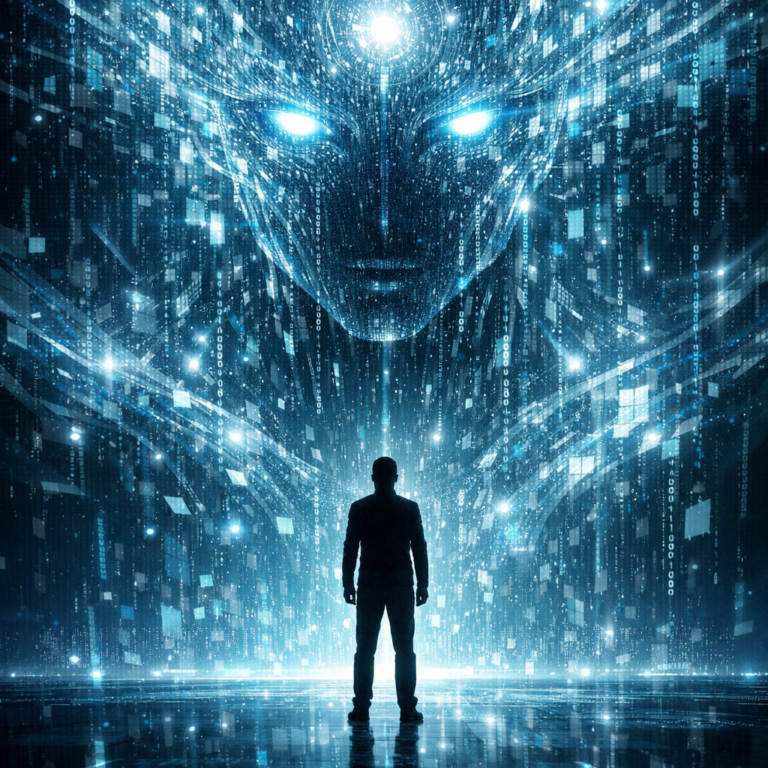
It describes a condition in which the intelligence shaping events is no longer exclusively human—and where the pace of its evolution outstrips our ability to understand or predict it.
The core is not intelligence.
It is speed.
When systems:
- design better systems
- automate research and analysis
- compress years of progress into months
- improve through recursive feedback
history stops unfolding at human speed.
Singularity is not a dramatic event.
It is a state in which we can no longer stand outside change to observe it.
And we may already be inside it.
Not the End of Humanity — The End of Superiority
A common misconception is that artificial intelligence threatens human existence.
It does not.
What it threatens is the narrative of human superiority.
Since nearly the beginning of our presence on this planet, humans defined themselves through dominance over other species. Not merely through strength—but through intelligence.
We were the species that:
- understood
- abstracted
- predicted
- engineered
Intelligence was not just a capability.
It was identity.
For the first time, intelligence is no longer exclusively human.
Not biologically.
Functionally.
And that does not erase us.
It strips us of a certainty we assumed permanent.
If Singularity Is Already Here, What Does It Mean to Be Human?
Perhaps, for the first time in centuries,
being human does not mean being the smartest entity in the room.
Almost everything we built—education, labor systems, merit structures—rests on the assumption that human intelligence is scarce and therefore valuable.
When knowledge is generated elsewhere,
when analysis is automated,
when performance detaches from human cognition,
the question is no longer technological.
It is existential.
What remains when superiority dissolves?
The Crisis Is Not Technological — It Is Meaning-Based
Societies struggle not because technology advances,
but because we lack a renewed definition of the human.
Productivity is insufficient.
Cognitive speed is insufficient.
Optimization is insufficient.
All of these can be replicated, scaled, and improved.
What does not scale easily:
- moral responsibility
- existential awareness
- meaning
- lived experience
- the burden of finitude
Machines do not fear death.
They do not carry memory as weight.
They do not experience consequence.
Humans do.
And perhaps that is where our true position resides.
No Turning Back
In every era of radical change, the same instinct appears: return.
Slow down.
Regulate harder.
Pause until comfort returns.
But history has no reverse gear.
Fire was not undone.
Printing was not recalled.
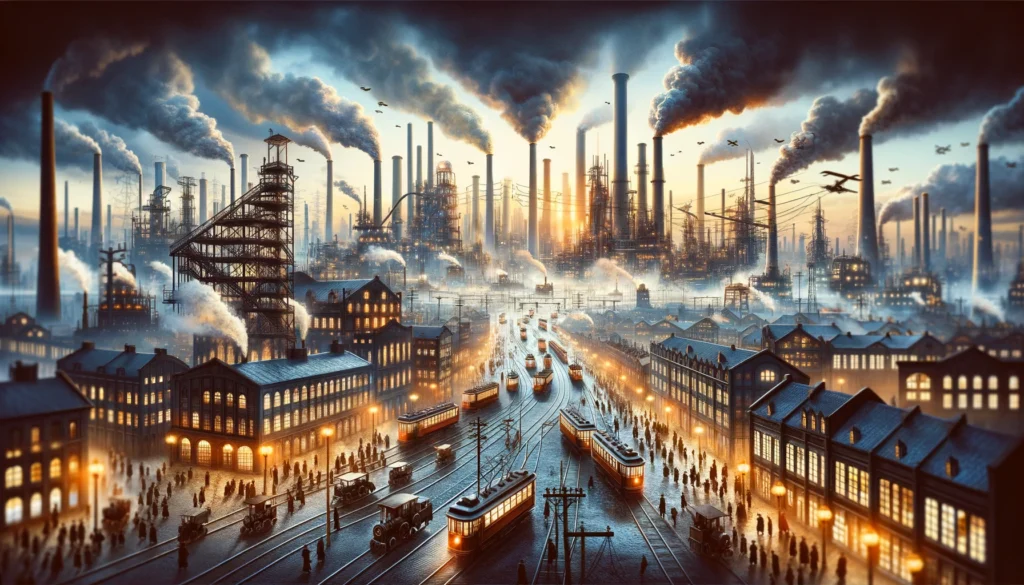
Industrialization was not reversed.
The internet was not withdrawn.
General-purpose technologies become irreversible conditions.
Artificial intelligence is not an exception.
It is the culmination.
There is no going back.
Only conscious adaptation—or denial.
And historically, denial has never preserved stability.
Closing
We are not witnessing the end of the human era.
We are witnessing the end of the era in which humans did not need to explain what they were.
If singularity is already unfolding,
it does not remove our humanity.
It removes our assumption that it was self-evident.
And perhaps that is the most human challenge we have faced in centuries.