
This article is a high-level, non-technical primer on how modern AI systems are assembled. It’s meant as a reference piece for readers who want to understand how the “magic” behind AI products actually works.
Modern AI often feels like magic.
You type something, click a button, or upload a document — and suddenly the system understands, responds, categorizes, or acts.
In reality, there is no single “AI brain” behind these experiences.
What users see as intelligence is the result of multiple components working together, each doing a very specific job.
This article explains, in simple terms, what pieces make up a modern AI system and how they cooperate to produce the results people experience as “AI”.
Why AI Looks Smarter Than It Is
Most AI-powered products don’t rely on one smart component.
They rely on coordination.
Think of AI systems less like a single intelligent being and more like:
- a production line,
- or a team where each member has one role.
The “magic” happens not because one component is brilliant,
but because the system is well assembled.
The Main Pieces of a Modern AI System
Let’s break down the core components you’ll typically find in real-world AI systems.
These explanations are intentionally simple and practical.
Large Language Models (LLMs)
An LLM is a system designed to generate and understand text patterns.
In practice, LLMs are used to:
- write text,
- summarize documents,
- classify content,
- translate between formats,
- answer questions in natural language.
An LLM does one thing very well:
it produces language that sounds right.
It does not:
- understand situations like a human,
- know what is important by itself,
- decide what should happen next.
On its own, an LLM is just a very advanced text engine.
Agents
An agent is not a smarter AI.
It is a way of organizing how an AI system behaves.
An agent usually:
- receives a goal (for example: “process this request”),
- uses an LLM to reason about the task,
- decides what step to take next,
- and repeats this process until the task is done.
You can think of an agent as:
“the coordinator” that decides what to do next.
Agents are what make systems feel interactive and goal-oriented.
Automation
Automation is the part that does things.
It:
- moves data,
- triggers workflows,
- sends emails,
- updates records,
- generates files or reports.
Automation does not think.
It simply executes instructions.
Once AI outputs are connected to automation, the system stops being a demo and starts becoming useful.
Rules and Logic
Rules define the structure and limits of the system.
They specify:
- required steps,
- allowed actions,
- validation checks,
- conditions for moving forward.
Rules are usually written by humans and are very explicit.
They act as guardrails that keep AI outputs usable and consistent.
Humans
Humans are part of almost every AI system.
They:
- provide input,
- review outputs,
- correct results,
- and trigger actions.
Even in highly automated systems, humans are often the ones who start or approve processes.
How These Pieces Work Together
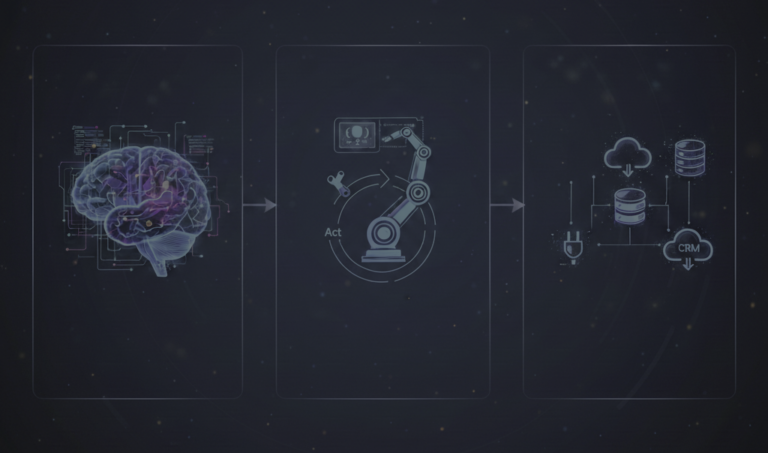
In a real system, these components operate as a pipeline.
A simplified flow looks like this:
- A human or system provides input
- Rules define what is allowed
- An LLM interprets or generates content
- An agent decides the next step
- Automation executes actions
- Results are stored or shown to users
No single component is responsible for the final outcome.
The result emerges from how they interact.
A Simple Real-World Example
Imagine an online platform that processes user submissions.
What the user sees
- They submit text and documents.
- The system responds quickly.
- Everything feels “smart”.
What actually happens behind the scenes
- Input arrives
A user submits a form with structured fields and free text. - Rules are applied
The system checks if required fields exist and formats are valid. - LLM processing
The LLM:- cleans up the text,
- extracts key information,
- classifies the submission.
- Agent coordination
The agent evaluates the result and decides:- whether more information is needed,
- whether to continue automatically,
- or whether to route it elsewhere.
- Automation executes
The system:- stores the data,
- generates a confirmation,
- updates internal records.
- Output to the user
The user sees a completed action — often within seconds.
What feels like “AI understanding everything”
is actually many simple steps working together smoothly.
Why This Perspective Matters
When people understand AI as a collection of cooperating parts:
- expectations become more realistic,
- system behavior makes more sense,
- and the “magic” becomes explainable.
AI systems are powerful not because they think like humans,
but because they combine models, logic, automation, and people effectively.
Closing Thought
Modern AI is not a single invention.
It is a carefully assembled system.
Once you understand the pieces and how they interact,
what looks like magic becomes engineering.