
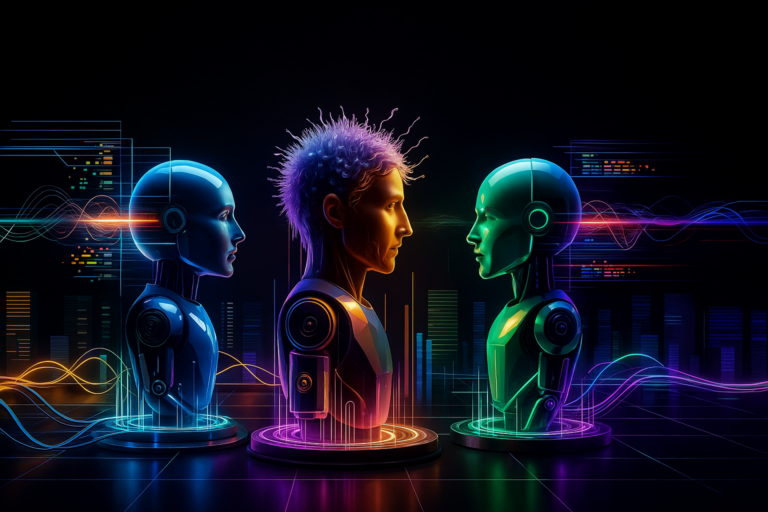
For the past two years, public discourse around Artificial Intelligence has revolved around two names: OpenAI and Anthropic.
Their rivalry — ideological, technical, commercial — is fascinating and important.
But there is a fundamental flaw in this narrative:
The world is obsessing over an OpenAI vs Anthropic duel while ignoring the biggest, most structurally powerful player in the field: Google.
This is not about hype.
Not about announcements.
Not about public demos.
It’s about infrastructure, compute, research depth, and the ability to deploy AI across real-world systems at planetary scale.
Even Sam Altman has started pointing in that direction.
Just weeks ago, he openly admitted:
“We are not comfortable.
The competition is stronger than ever.”
He wasn’t talking about Anthropic alone.
He was signaling something deeper.
Let’s break down what most people are missing.
1. OpenAI vs Anthropic: A battle of narratives, not dominance
OpenAI
- shaped global perception with ChatGPT
- excels in reinforcement learning and human alignment
- is pushing toward autonomous agents and real-world workflows
- moves fast and captures attention
Anthropic
- built a reputation on safety and reliability (Constitutional AI)
- offers long-context, highly stable models
- positions itself as the enterprise-safe alternative
- focuses on predictable, controlled behavior
This rivalry is meaningful — but also misleading.
Because in reality:
Neither OpenAI nor Anthropic controls the deeper layers of AI infrastructure.
That position belongs elsewhere.
2. What Sam Altman knows — and the public does not
In a rare moment of candor, Altman said:
“Google’s technical progress is impressive,
and when they decide to move aggressively, we expect significant acceleration.”
This was not a compliment.
It was a warning.
Altman understands something crucial:
Google has capabilities that neither OpenAI nor Anthropic can match yet.
We’re talking about:
- the world’s largest integrated data ecosystems
- state-of-the-art compute hardware (TPUs)
- unmatched experience in distributed systems
- DeepMind + Google Research working together
- robotics, maps, logistics, and multi-modal datasets
- a global infrastructure footprint
- real-world deployment environments (Waymo, YouTube, Search)
OpenAI has the narrative.
Anthropic has the discipline.
But Google has the infrastructure.
3. Google is not entering the race — Google is the race
There is a difference between companies that fight to reach the frontier
and companies that are already sitting on top of the foundation.
Google today:
✔ has the most mature technology stack
✔ trains some of the most efficient multimodal models (Gemini Ultra)
✔ owns both the hardware and the inference layer
✔ operates at global scale across billions of users
✔ integrates AI into real physical systems, not only APIs
✔ has robotics deployments no competitor can replicate
✔ controls distribution channels: Android, Chrome, Search, Maps, YouTube
While OpenAI and Anthropic fight over developer mindshare and API pricing,
Google quietly controls:
- the data layers
- the hardware layers
- the infrastructure layers
- the global deployment channels
And when you control data + hardware + distribution,
the competitive landscape becomes fundamentally asymmetric.
4. Why the public narrative underrates Google
Because Google:
• doesn’t market aggressively
• doesn’t rely on hype for fundraising
• reveals only a fraction of its progress
• has institutional momentum — not startup energy
• is evaluated by media through “consumer product launches”
rather than infrastructure
OpenAI and Anthropic are narrative companies — the world sees everything they do.
Google is an infrastructure-first company — most of its breakthroughs happen silently.
5. Who is really ahead? It depends on the layer.
There is no single leaderboard.
There are layers of advantage.
OpenAI leads in:
- consumer adoption
- agents and behavioral systems
- cultural dominance (the ChatGPT effect)
- rapid iteration and deployment
- developer ecosystem
Anthropic leads in:
- reliability
- safety frameworks
- long-context reasoning
- enterprise-grade controls
- predictable model behavior
Google leads in:
- multimodal understanding at scale
- TPU acceleration and training efficiency
- robotics and embodied intelligence
- global data pipelines
- foundational research
- distribution ecosystems
- real-world deployment beyond chat interfaces
In other words:
- OpenAI looks ahead.
- Anthropic looks stable.
- Google is playing a different game entirely.
6. Sam Altman’s real concern: dependence on compute
Altman has repeatedly acknowledged:
“Our progress is limited by access to compute.”
This should not be overlooked.
Because:
✔ OpenAI depends on Microsoft
✔ Anthropic depends on Amazon
✔ Google depends on no one
Google builds its own hardware.
Runs its own global cloud.
Controls its own network.
Optimizes its own training stack.
OpenAI and Anthropic buy horsepower.
Google manufactures it.
This is a structural advantage that no PR battle can erase.
7. What this means for the next 24 months
While OpenAI and Anthropic compete for API market share,
the real frontier battle will shift toward:
- agentic systems connected to the physical world
- multimodal robotics
- personalized on-device inference
- sovereign AI models for governments
- end-to-end AI infrastructure
- energy-efficient training architectures
And in these domains, Google is exceptionally strong.
When it decides to accelerate publicly — not just internally —
the landscape could shift dramatically.
This is what Altman likely anticipates.
And this is why he no longer speaks with the confidence of 2023–2024.
The real competitor is not the one in the headlines
OpenAI dominates the narrative.
Anthropic dominates the enterprise trust conversation.
But Google dominates the foundations.
And in races defined by infrastructure,
foundations win.
The OpenAI–Anthropic rivalry is important.
But it might also be a distraction.
The real question for the industry is:
What happens when Google stops holding back?
P.S. A short note on what “narrative” actually means.
In technology — and especially in AI — narrative simply means the story people believe about a company or a technology, regardless of what is technically true behind the scenes.
A narrative is not marketing.
It’s the public perception:
who seems fast, who seems innovative, who seems ahead.
OpenAI and Anthropic currently dominate the narrative because their work is visible and widely discussed.
Google often appears quieter — but only because infrastructure companies don’t communicate their progress in the same way.
And that’s why narrative can mislead us:
it tells us who is winning the story,
not who is winning the foundations.
Understanding the difference between public narrative and actual capability is essential if we want to see where AI is truly heading.