
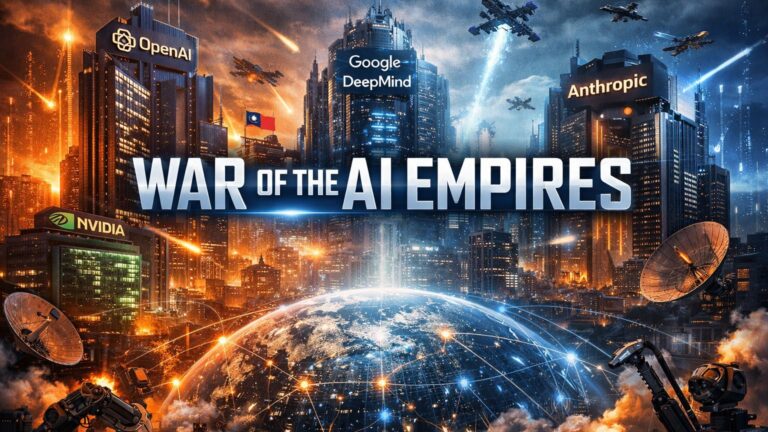
In 1898, War of the Worlds described a humanity caught off guard.
Not defeated because it was weak — but because it failed to understand the nature of the threat until it was already everywhere.
That’s why the metaphor matters today.
We are not living a science-fiction scenario of machines rising against humans.
We are living something quieter, more systemic, and far more realistic:
a war between AI empires.
Not models versus models.
Not intelligence versus intelligence.
But platforms, ecosystems, and infrastructures competing to become the invisible layer beneath modern decision-making.
This Is Not AI vs Humans — It’s Ecosystems vs Ecosystems
Public discourse often frames AI as a confrontation:
“Will machines replace us?”
That framing is misleading.
What’s happening is not replacement — it’s re-architecture.
AI systems are increasingly embedded into:
- enterprise workflows
- operational decision chains
- compliance processes
- analytics and reporting
- customer interaction layers
And crucially:
AI systems are now interacting with other AI systems.
Agents negotiate with agents.
Detection models respond to generation models.
Automation pipelines trigger automated remediation.
Humans are still present — but mostly as supervisors, policy-setters, and exception handlers.
This is not a rebellion.
It’s a structural shift of agency.
Why “War of the Worlds” Is a Precise Metaphor
In War of the Worlds, the most terrifying element isn’t destruction — it’s asymmetry.
Humans don’t understand:
- the attackers’ technology
- their objectives
- or the rules of engagement
That’s the parallel.
Today, most organizations:
- deploy AI tools without understanding their systemic impact
- integrate platforms without modeling long-term dependency
- automate decisions without formal governance structures
The danger isn’t malicious intent.
The danger is scale without comprehension.
This Is Not a War of Models — It’s a War of Platforms
The biggest misconception in AI discussions is focusing on “the best model”.
Models matter — but they are replaceable.
Platforms are not.
The real battle is fought across five strategic layers:
1) Compute Infrastructure
Who controls large-scale, cost-efficient compute?
AI is not software alone.
It is industrialized computation.
Access to GPUs, specialized accelerators, and optimized inference pipelines determines:
- speed of iteration
- cost per action
- feasibility of large-scale agents
Compute is no longer neutral infrastructure.
It is strategic leverage.
Data & Feedback Loops
Not just training data — but operational data.
What matters most is:
- real-world usage feedback
- task execution traces
- correction signals
- workflow outcomes
When AI is embedded into daily operations, it learns from reality, not theory.
This creates data flywheels that are extremely hard to replicate externally.
Distribution & Default Presence
The most powerful platform is not the smartest one.
It’s the one that becomes:
- the default assistant
- the default API
- the default enterprise choice
- the default “safe option”
Distribution beats brilliance.
Being embedded into:
- productivity tools
- cloud contracts
- developer workflows
- compliance pipelines
creates inertia that no benchmark can overcome.
Agent Ecosystems
Agents change everything.
A chatbot answers.
An agent acts.
Agents:
- execute workflows
- access systems
- move data
- trigger processes
This shifts AI from “tool” to operational actor.
And once AI becomes an actor, the questions change:
- Who is responsible?
- How do we audit actions?
- How do we prevent silent failure?
- How do we constrain scope?
Empires are built where agents live.
Governance & Regulation
Contrary to popular belief, regulation is not the enemy of scale.
It is the enemy of careless scale.
In regulated environments (especially Europe), platforms that offer:
- traceability
- explainability
- auditability
- risk classification
will outcompete faster but opaque systems.
Governance is becoming a competitive differentiator, not a brake.
The Hidden Battlefield: Lock-In vs Sovereignty
Every AI platform aims to become:
- the decision layer
- the orchestration layer
- the compliance layer
- the accountability layer
Once that happens, switching is no longer technical.
It becomes:
- organizational
- procedural
- cultural
This is how empires form:
not through force, but through dependence.
The Real Risk Is Not AI — It’s Misalignment at Scale
The most dangerous scenario is not “evil AI”.
It is:
- rushed deployment
- misaligned incentives
- automation without observability
- decision-making without accountability
Misalignment scales faster than intelligence.
And once embedded, it becomes invisible.
What Organizations Must Do Now
The right question is not:
“Which AI should we use?”
It is:
“How do we retain control, visibility, and choice?”
That means:
- AI governance from day one
- clear responsibility boundaries
- full action logging for agents
- data integrity and provenance
- architectural separation between data, logic, and interface
This is not about slowing down innovation.
It’s about making it survivable.
Conclusion: Why This War Is Already Underway
The war of the AI empires is not coming.
It’s already here — just not where most people are looking.
It’s happening:
- in cloud contracts
- in enterprise workflows
- in automated decisions
- in invisible dependencies
And like War of the Worlds, the greatest danger is not destruction.
It is not realizing what kind of war you are already in.
The future will not belong to the smartest AI.
It will belong to the most deeply embedded one.