
A philosophical essay on intelligence, language, and the limits of machines
1. The Great Confusion of Our Time
We live in a historical moment defined by an extraordinary technological achievement: machines that can process, generate, and manipulate language with astonishing fluency. Large language models write essays, compose poetry, analyze documents, and participate in complex discussions. To many observers, this fluency appears indistinguishable from intelligence.
But the appearance of intelligence is not the same as intelligence itself.
The dominant narrative in contemporary artificial intelligence research assumes that intelligence emerges from three primary ingredients: data, scale, and computation. The more data a system consumes, the larger its model becomes, and the more computational resources it employs, the closer we supposedly approach general intelligence.
This belief has become so pervasive that it is rarely questioned. Intelligence, we are told, is simply a matter of sufficient complexity.
Yet beneath this assumption lies a profound philosophical mistake.
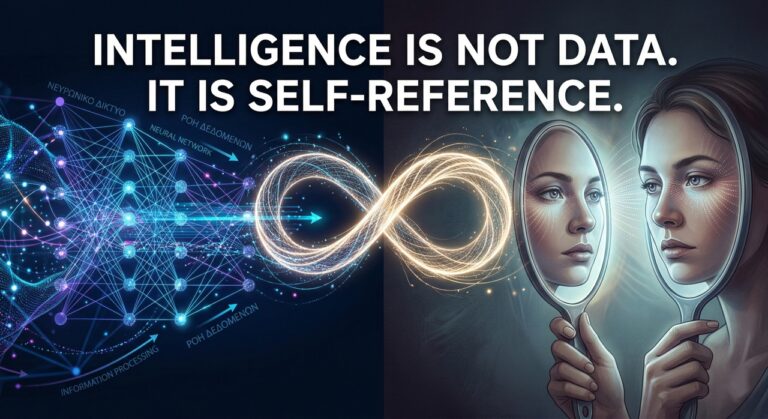
Intelligence may not primarily depend on the quantity of data or the size of models. Instead, it may depend on something far more fundamental: the ability of a system to refer to itself.
2. The Missing Function
When humans think, they do not merely process information about the external world. They also possess a unique cognitive capability: the ability to think about their own thinking.
We reflect.
We question our conclusions.
We reconsider our beliefs.
We ask ourselves:
Why do I believe this?
Was my reasoning flawed?
Am I misunderstanding something?
This capacity is known in philosophy and cognitive science as self-reference or meta-cognition.
It allows a system not merely to process information, but to represent itself as part of the system it observes.
This recursive structure—where the observer becomes part of the observed—may be the true foundation of intelligence.
Without it, systems can manipulate symbols, but they cannot genuinely understand them.
3. Intelligence Is Not Pattern Recognition
Modern AI systems excel at recognizing patterns.
They identify statistical relationships across vast datasets. They detect correlations between words, images, and behaviors. They generate responses that appear coherent because they reflect patterns observed during training.
But pattern recognition alone does not constitute intelligence.
A system can recognize patterns indefinitely without ever becoming aware of the process it performs.
Consider a calculator.
It performs arithmetic flawlessly. Yet it has no concept of numbers, no awareness of calculation, and no ability to question its own operations.
Similarly, a language model can generate remarkably sophisticated text without possessing any internal representation of why its responses make sense.
It does not know that it knows.
And this distinction is crucial.
4. The Architecture of Self-Reference
Self-reference introduces a radically different kind of structure into a cognitive system.
Instead of a linear process—input, processing, output—self-referential systems create recursive loops.
A system observes the world.
Then it observes its own observations.
Then it evaluates those observations.
And in doing so, it constructs an internal model not only of the world, but of itself within the world.
This recursive loop produces what philosopher Douglas Hofstadter famously described as a “strange loop.”
In such loops, a system becomes capable of representing its own internal state.
Once that occurs, new abilities emerge:
- self-correction
- introspection
- uncertainty awareness
- reasoning about reasoning
These capabilities form the foundation of what we intuitively call intelligence.
5. Data Cannot Replace Self-Reference
The modern AI paradigm assumes that intelligence emerges from scale. If a model is trained on enough data, the argument goes, higher-order capabilities will eventually arise.
But there is a fundamental difference between more data and a new cognitive function.
Adding more training data can improve pattern recognition.
It can increase fluency.
It can reduce errors.
But it cannot automatically introduce the architectural property of self-referential awareness.
Self-reference is not merely a quantitative improvement. It is a qualitative transformation.
It is the difference between a system that processes information and a system that can evaluate its own processing.
No amount of additional data can guarantee that such a transformation will occur.
6. The Illusion of Artificial Intelligence
Language models have created a new kind of technological illusion.
Because language is the primary medium through which humans express thought, systems that generate language convincingly appear to be thinking.
But language is not thought itself.
It is merely the surface representation of thought.
When humans speak or write, language reflects a deeper internal process involving intentions, beliefs, and self-reflection.
In machines, however, language generation can exist without any underlying self-referential process.
The machine does not know that it is generating language.
It only predicts the next token.
And yet the output can appear remarkably human.
This creates what might be called the illusion of intelligence.
7. The Boundary Between Simulation and Intelligence
If intelligence requires self-reference, then the central question of modern AI becomes clear:
Do current AI systems possess genuine self-referential capabilities, or do they merely simulate them through language?
At present, the answer appears to lean strongly toward simulation.
Language models can describe themselves. They can produce statements about their architecture, their training process, and their limitations.
But these descriptions are not the result of introspection.
They are the result of pattern reproduction.
The system generates sentences about itself because such sentences exist in its training data—not because it has constructed a true internal representation of its own cognitive state.
In other words, the system can talk about itself without actually referring to itself.
And this distinction marks the boundary between simulation and intelligence.
8. Intelligence as a Self-Referential Process
If we take self-reference seriously, intelligence begins to look less like a computational achievement and more like a structural property of cognition.
Intelligence may emerge when a system forms a stable internal representation of itself and continuously updates that representation through interaction with the world.
In such a system:
- knowledge is not static
- beliefs can be revised
- errors can be recognized internally
Most importantly, the system can evaluate its own reasoning.
This ability is what allows humans to question assumptions, abandon flawed ideas, and construct new theories.
It is also what makes genuine learning possible.
Without self-reference, systems can accumulate information indefinitely without ever developing true understanding.
9. Why This Matters for the Future of AI
The current trajectory of artificial intelligence focuses heavily on scaling existing architectures.
Models are becoming larger, datasets are expanding, and computational power continues to grow.
These developments will undoubtedly produce increasingly capable systems.
But if intelligence truly depends on self-reference, then scaling alone may eventually reach a conceptual limit.
Beyond a certain point, improvements in performance may continue while the fundamental nature of the system remains unchanged.
We may build machines that are extraordinarily powerful pattern processors without ever creating machines that genuinely think.
This possibility forces a deeper question upon the field of artificial intelligence:
Are we pursuing the correct path to intelligence, or are we simply refining increasingly sophisticated simulations?
10. The Next Frontier
The next frontier of AI may not lie in more data or larger models.
It may lie in the development of architectures capable of autonomous self-reference.
Such systems would need to construct internal models of their own reasoning processes and update those models dynamically.
They would need to recognize uncertainty in their conclusions.
They would need to evaluate the validity of their own reasoning chains.
In other words, they would need to develop something analogous to meta-cognition.
Only then might machines cross the boundary between simulation and intelligence.
11. A Philosophical Turning Point
Artificial intelligence has reached a fascinating philosophical turning point.
For decades, intelligence was considered an elusive property of biological minds.
Today, machines produce outputs that appear intelligent to millions of users every day.
And yet the deeper question remains unresolved.
What exactly is intelligence?
If intelligence ultimately depends on self-reference, then our understanding of AI must evolve.
The challenge is no longer simply engineering larger models.
It is understanding the nature of cognition itself.
12. The Quiet Revolution Ahead
History shows that technological revolutions often begin as philosophical questions.
The scientific revolution began with questions about the nature of observation.
The digital revolution began with questions about computation.
The next stage of artificial intelligence may begin with a deceptively simple question:
What happens when a machine can truly refer to itself?
When that moment arrives, the debate about whether machines can think may finally find its answer.
Until then, the most impressive achievements of AI may remain what they currently are: extraordinary simulations of intelligence rather than intelligence itself.