The Undeclared War for AI
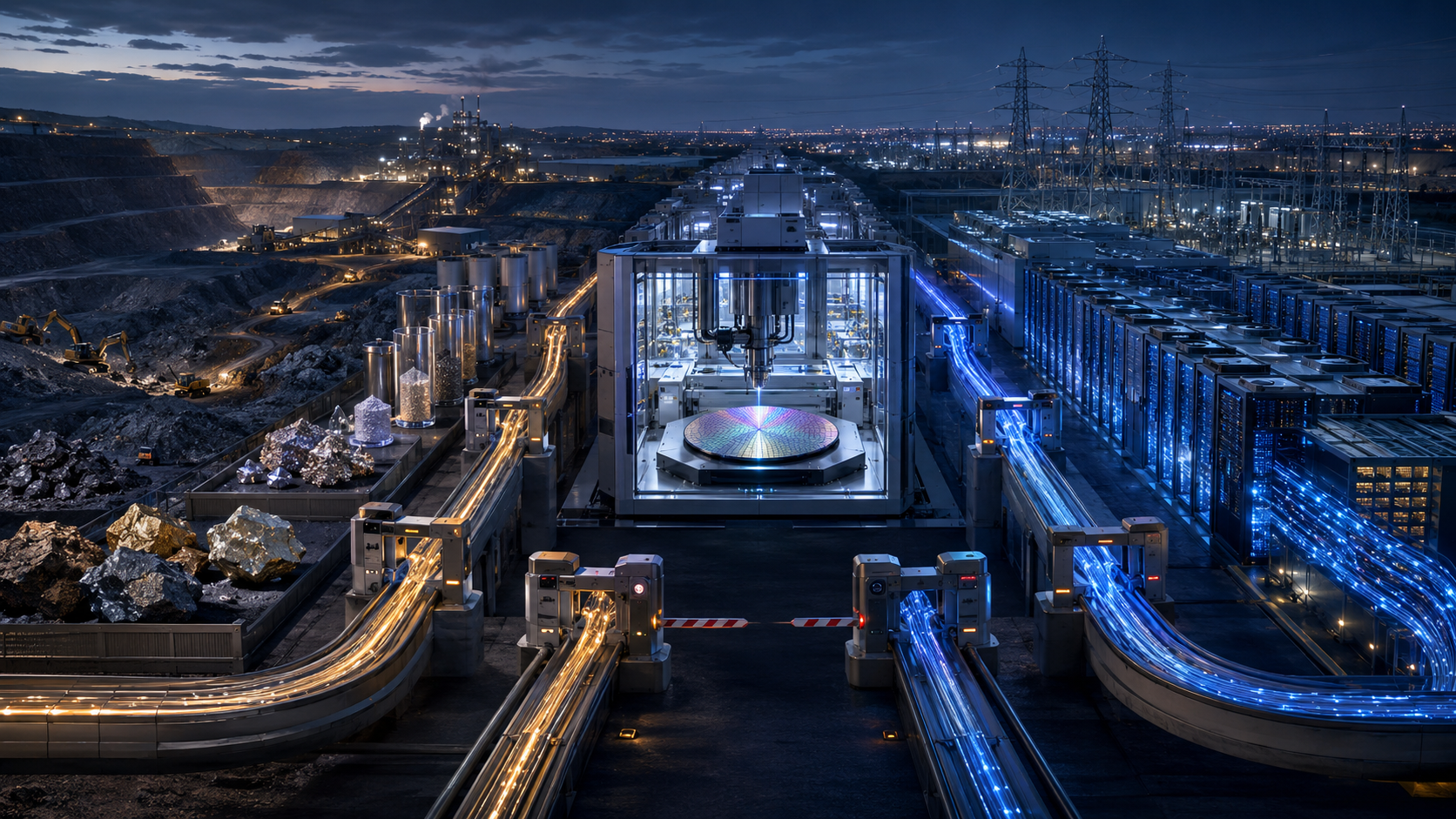
Can You Dominate What You Cannot Produce?
When the European Union announced plans to establish up to seven AI Megafactories, supported by as much as €10 billion in public funding and intended to mobilise more than €30 billion in total investment, the initiative was presented as a major step towards European technological sovereignty.
And it is.
Without computing capacity, data centres, energy infrastructure and access to advanced processors, Europe risks remaining primarily a consumer of artificial intelligence systems developed, trained and controlled elsewhere.
But a much broader pattern is emerging behind the European initiative.
At the same time, the United States is considering new restrictions on Chinese data-centre components. China is subjecting American cybersecurity products to national-security reviews. The Netherlands requires export licences for critical semiconductor-manufacturing equipment. China controls exports of rare-earth materials. The European Union is proposing mechanisms to remove suppliers from third countries from critical digital infrastructure.
None of these measures constitutes a declaration of war on its own.
Placed together, however, they reveal an undeclared global struggle for control over the infrastructure on which the age of artificial intelligence will operate.
The war is not only between models
The public conversation about AI tends to focus on models.
Which company has built the most powerful system? Which model writes better code? Which has more parameters, lower costs or stronger benchmark performance?
These questions matter. But they concern only the most visible layer of a much larger system.
Behind every advanced model lies a chain that includes:
- critical minerals and processed materials,
- semiconductor-manufacturing equipment,
- fabrication plants and advanced packaging,
- processors and memory,
- optical transceivers and network equipment,
- energy, water and electricity grids,
- data centres and cloud platforms,
- software, development tools and cybersecurity,
- data, specialist knowledge and capital,
- real demand from businesses and public organisations.
A model may be developed in the United States, trained on chips manufactured in Taiwan using equipment based on Dutch technology, contain materials processed in China and operate inside data centres assembled from components produced across several different countries.
This is not a failure of the system. It is the result of decades of global specialisation.
But it is also a map of potential pressure points.
Government restrictions reveal the real chokepoints
The restrictions governments are imposing are not random. They follow the parts of the technology chain that are most concentrated and hardest to replace.
The United States has created an extensive system of controls governing the export of advanced processors and semiconductor-manufacturing technology to China. The rules are not static. In January 2026, for example, the US Department of Commerce moved to review exports of Nvidia H200, AMD MI325X and similar processors on a case-by-case basis, subject to specific security, testing and compliance conditions.
The broader principle remains clear: access to advanced computing power is now treated as an instrument of national policy rather than an ordinary commercial transaction. US Bureau of Industry and Security, 13 January 2026
The controls do not end with the chips themselves.
In August 2025, the Bureau of Industry and Security closed an exemption that had allowed certain foreign-owned semiconductor plants in China to receive US equipment and technology without individual export licences. The agency said it intended to permit existing facilities to continue operating, but did not plan to approve licences for expanding their capacity or upgrading their technology. US Bureau of Industry and Security, 29 August 2025
The Netherlands, which occupies a unique position in advanced semiconductor-manufacturing equipment, expanded its export-authorisation requirements from 1 April 2025 to cover additional measurement, inspection and chip-production technologies.
The measure applies to exports outside the European Union and is not a general prohibition. It does, however, give the Dutch government authority over who may obtain technology that is extremely difficult to reproduce elsewhere. Government of the Netherlands
China controls different points of leverage.
In April 2025, it introduced export controls covering categories of medium and heavy rare earths, including samarium, terbium and dysprosium, together with certain alloys, oxides and permanent-magnet materials used in advanced industrial, energy and defence applications. Exports were not prohibited altogether, but they became subject to state approval. Ministry of Commerce of China, 4 April 2025
The United States can therefore influence access to advanced processors, software and design technology. The Netherlands controls essential equipment without which the most advanced chips cannot be manufactured. China holds powerful positions in materials, industrial processing and component manufacturing. Taiwan and South Korea retain critical capacity in fabrication, packaging and memory.
No country controls the entire chain.
Each is attempting to control a point that the others cannot easily bypass.
Geopolitics is moving inside the data centre
Until recently, most restrictions focused on the obvious strategic assets: semiconductors, telecommunications equipment and clearly defined dual-use technologies.
Now government scrutiny is moving deeper inside the infrastructure.
On 4 August 2026, Reuters reported that the US Federal Communications Commission was developing a possible restriction on imports of new Chinese optical-transceiver models.
These devices convert electrical signals into light and allow enormous volumes of data to move through the fibre networks connecting thousands of processors inside AI data centres.
At the time of writing, the restriction had not been published. According to the report, it could still be changed or abandoned. Yet the fact that it is being considered is itself revealing.
Governments are no longer asking only who manufactures the processor. They are beginning to ask who manufactures the components that allow thousands of processors to communicate inside the same building. Reuters, 4 August 2026
The FCC already maintains an official list of equipment and services considered to pose a threat to US national security. It includes products from companies such as Huawei and ZTE, while authorisations for new models of certain Chinese telecommunications and surveillance equipment have been restricted. FCC Covered List
The logic is preventive: stop a supplier from becoming so deeply embedded in critical infrastructure that replacing it later becomes prohibitively expensive or operationally impossible.
Only days after the report about optical transceivers, China initiated a formal cybersecurity review of products sold in the country by Palo Alto Networks.
The announcement by the Cyberspace Administration of China refers to the stable operation of critical information infrastructure, the prevention of cybersecurity risks and the protection of national security. It does not specify which products are under examination or identify particular technical vulnerabilities.
At this stage, it is a review, not a final prohibition. Cyberspace Administration of China, 6 August 2026
This creates a revealing reversal.
The United States treats Chinese networking equipment as a potential mechanism for access, espionage or operational disruption. China is applying almost the same argument to American cybersecurity software.
Both sides are effectively saying the same thing:
A critical system cannot be treated as neutral when its manufacturer, updates, telemetry or legal obligations are controlled by a geopolitical competitor.
Europe stands between two technological worlds
Europe is not merely observing this struggle.
The European Commission has assessed Huawei and ZTE as presenting materially higher risks than other 5G suppliers and has urged EU member states and telecommunications operators to restrict or remove their equipment from European networks. European Commission — 5G Cybersecurity Toolbox
In January 2026, the Commission proposed a revision of the Cybersecurity Act that would allow the European Union to address risks associated with third-country suppliers across critical ICT supply chains.
The proposal goes beyond the technical security of an individual product. It also considers dependencies, foreign interference and risks associated with the supplier itself. It is not yet fully enacted law, but it clearly indicates the direction of European policy. European Commission — revised Cybersecurity Act
At the same time, Europe knows that removing foreign suppliers is not enough when sufficient alternatives do not exist.
According to an analysis by the European Commission’s Joint Research Centre, the EU accounted for approximately 10.6% of worldwide semiconductor shipments in 2023. Europe holds a strong position in manufacturing equipment, particularly microlithography, but remains dependent on imports of final semiconductor products, especially logic and memory chips sourced from Asia.
For some categories, the ability to replace imports with European production remains limited. European Commission Joint Research Centre
This is the real context in which the AI Megafactories must be assessed.
The facilities are necessary. But a Megafactory does not eliminate dependency simply by moving the data centre onto European soil.
It concentrates the dependencies of the entire chain within one enormous project: processors, networking equipment, software stacks, energy, manufacturers and capital.
The European Commission itself states that the Megafactories will combine advanced AI processors, cloud technologies, software stacks, high-speed connectivity and energy-efficient data centres. European Commission, 30 July 2026
That description is not merely a list of technologies.
It is also a list of dependencies.
Can you dominate what you cannot produce?
The answer is not a simple no.
The United States does not manufacture domestically every chip designed by its companies. Yet it controls critical intellectual property, chip-design software, cloud platforms, AI models, capital and a substantial part of global demand.
Europe does not produce the most advanced AI processors at sufficient scale. But it possesses irreplaceable semiconductor-manufacturing technology, major research capabilities, valuable industrial data, a powerful internal market and the regulatory ability to determine the conditions under which companies may access that market.
China does not yet have unrestricted access to the entire advanced Western semiconductor stack. But it possesses an enormous industrial base, critical materials, integrated supply chains, domestic demand and the ability to direct capital towards strategic industrial objectives at extraordinary scale.
A country does not need to produce everything to acquire power.
It must control something that others cannot replace easily, quickly and economically.
That may be a factory. It may be a lithography machine, a critical mineral, an operating system, a cloud platform, a technical standard, a distribution network or access to a major market.
Dominance does not necessarily result from controlling the whole chain.
It can result from controlling the chokepoint through which the rest of the chain must pass.
Companies are not outside this conflict
It would be too simplistic to assume that behind every government decision lies a corporation secretly directing events.
But it would be equally naive to believe that states and major technology companies operate independently.
Governments need companies because companies possess the technology, patents, infrastructure, specialist talent and operational capability.
A government cannot simply decide that it will create an advanced semiconductor industry or a competitive AI stack and bring it into existence through legislation.
Companies, in turn, need governments for funding, tax incentives, energy access, public land, contracts, intellectual-property protection and restrictions on competitors.
Europe’s AI Megafactories are explicitly described as industry-led projects supported by up to €10 billion in European and national public funding and expected to mobilise at least €20 billion in private capital.
This is not evidence of conspiracy.
It is an alignment of interests.
Governments seek security, autonomy, growth and geopolitical influence. Companies seek markets, financing and long-term positions inside critical infrastructure.
When these interests converge, industrial policy and corporate strategy begin to operate as parts of the same system.
When national security becomes industrial policy
Almost every restriction is presented as a national-security measure.
In many cases, the risks are real. A networking component, firewall, cloud service or remote-update mechanism can genuinely create a possibility of unauthorised access or operational disruption. Excessive dependence on a single supplier is also an objective strategic vulnerability.
At the same time, every restriction creates economic winners.
When Chinese processors or network components are restricted, American or allied suppliers benefit. When China limits the use of Western cybersecurity products, space is created for domestic alternatives. When Europe finances its own infrastructure and proposes the removal of high-risk suppliers, public and private capital is directed towards a more European technology ecosystem.
National security and industrial policy are no longer clearly separated domains.
The problem is that the more security is used as an instrument of economic competition, the harder it becomes to distinguish between a restriction addressing a demonstrated risk and one primarily protecting a domestic market.
That distinction matters.
Otherwise, the world may move from a highly efficient but fragile global supply chain towards several more expensive and incompatible technology ecosystems—without necessarily becoming safer.
Sovereignty is not self-sufficiency
Complete technological self-sufficiency is probably impossible.
Even the world’s most powerful economies depend on foreign expertise, materials, equipment, markets and manufacturing capacity. Attempting to replicate the entire technology chain within every country would be enormously expensive and would create new inefficiencies.
But the alternative cannot be blind dependence.
Real technological sovereignty means that a state or economic union:
- understands its critical dependencies,
- can identify who controls them,
- maintains more than one credible supplier,
- holds reserves and alternatives for components that cannot be replaced quickly,
- possesses productive knowledge rather than merely finished products,
- can maintain and operate its systems under pressure,
- controls at least some critical points in the chain,
- cooperates with allies without confusing partnership with the absence of risk.
Sovereignty, therefore, is not the elimination of every dependency.
It is the transformation of dependency from a blind vulnerability into a conscious, manageable and replaceable relationship.
The undeclared war has already begun
There are no soldiers surrounding the data centres.
There are export licences, prohibited-supplier lists, public subsidies, cybersecurity reviews, investment restrictions and domestic-production requirements.
Territory is not being occupied.
Positions within value chains are.
Ports are not being blockaded.
Access to chips, equipment, materials, models and markets is being restricted.
The objective is not necessarily for one country to control every technology on the planet. It is to acquire sufficient power at critical points to influence what others can produce, purchase and continue operating.
Can you dominate something you cannot produce?
For a time, yes—if you control its design, capital, software, standards or market.
But that dominance remains fragile when it depends on a production process you do not understand, cannot reproduce and have no way to replace.
You do not need to manufacture everything to be powerful.
But you must produce, own or control something that others need.
Otherwise, you do not possess technological sovereignty.
You possess access to a technology that continues to function only for as long as those controlling its real productive foundations allow you to use it.