Europe Is Building AI Sovereignty on Infrastructure It Does Not Yet Control
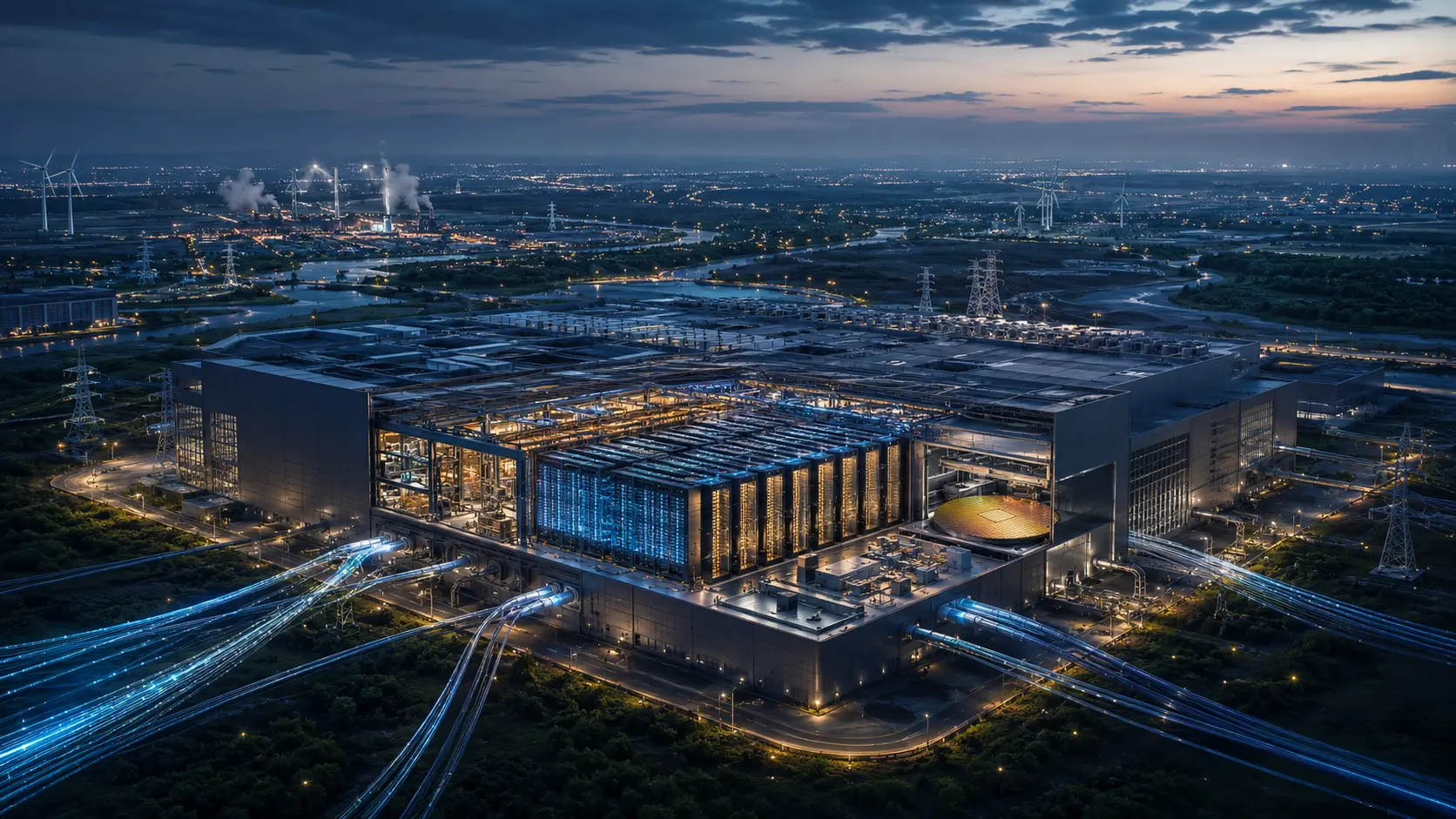
Europe has decided to invest seriously in the infrastructure of artificial intelligence.
On 30 July 2026, the European Commission launched a call to establish up to seven AI Gigafactories. The plan provides for as much as €10 billion in EU and national public funding, with the intention of attracting at least another €20 billion in private investment.
These will not simply be larger data centres. The facilities are expected to combine advanced AI processors, cloud and software stacks, high-speed connectivity and energy-efficient infrastructure. Operating alongside Europe’s network of 19 smaller AI Factories, they will provide computing capacity to companies, research institutions, startups and public authorities. European Commission, 30 July 2026
The investment is necessary. Without access to large-scale computing power, Europe cannot train advanced models, retain research talent or build globally competitive AI companies.
But behind the impressive €30 billion figure lies a more difficult question.
If the facilities are located in Europe, but their processors, cloud software, models, critical supply chains and major technology providers remain outside European control, what exactly is sovereign?
Location is not sovereignty
In public debate, we often treat geographical location as a substitute for control.
A data centre is located in France, Germany or Italy. Its data remains inside the European Union. The facility complies with European law. We therefore describe it as European—or sovereign.
These are important characteristics, but they are not sufficient.
A building can stand on European soil while operating with processors designed in the United States and manufactured in Asia. It may depend on proprietary cloud platforms, management software and development tools controlled by companies outside Europe.
It may also rely on support agreements, software licences, security updates and supply chains over which its European operator has limited influence.
Keeping data in Europe answers the question: “Where is it stored?”
It does not automatically answer several other questions:
- Who controls the technology processing it?
- Which jurisdiction governs the provider?
- Who can discontinue support?
- How easily can a critical component be replaced?
- Can the infrastructure continue operating if the geopolitical or commercial environment changes?
It is revealing that the European Commission’s own Cloud Sovereignty Framework does not reduce sovereignty to data location. It evaluates cloud services across eight objectives, including strategic, legal and jurisdictional sovereignty, operational control, supply-chain transparency, technological openness, security and control over data and AI. European Commission — Cloud Sovereignty Framework
Sovereignty, therefore, is not a property of a building. It is a property of the entire system.
The sovereignty stack
To understand what Europe genuinely controls, we need to examine the full stack.
At its physical foundation are land, energy, water, cooling and access to the electricity grid. Above them sit the data centres, network connections and hardware. Then come the processors, cloud platforms, management software, frameworks, models and data.
There are also less visible layers: financing, ownership, maintenance capability, skilled personnel, supplier agreements and, ultimately, sufficient demand to keep the infrastructure economically viable.
A country—or an entire continent—may control some of these layers while remaining almost completely dependent on external actors for others.
This is why we need a more mature understanding of technological sovereignty: not as a political slogan, but as a map of dependencies.
The processor problem
AI Gigafactories require enormous numbers of advanced accelerators. Today, the most powerful of these are primarily designed by American companies, while their production depends heavily on Asian foundries.
Europe controls important parts of the global semiconductor supply chain. ASML, for example, is a critical supplier of the equipment required to manufacture advanced chips. Europe also has strong research centres and companies with significant positions in industrial, automotive and power semiconductors.
That does not mean Europe currently possesses competitive and sufficient production capacity for the processors required by frontier AI.
The European Court of Auditors has already warned that the EU is very unlikely to reach its objective of securing 20% of the global semiconductor market by 2030. Its report acknowledged the momentum created by the European Chips Act but highlighted fragmented funding, delays and a persistent gap between political ambition and industrial capacity. European Court of Auditors
The European Commission itself presents the AI Gigafactories as a way to generate predictable demand that may eventually stimulate the design and production of European AI processors.
The word “eventually” matters.
It means Europe needs to build today’s infrastructure largely with technology it does not control, hoping that the resulting demand will help create European alternatives tomorrow.
That is not necessarily a mistake. But it is a dependency, and it should be recognised as one.
The building may be European. The software stack may not be.
Even if Europe solved the processor problem, its software dependency would remain.
Modern AI infrastructure consists of far more than servers. It requires orchestration, cloud management, developer tools, databases, observability, cybersecurity, machine-learning frameworks and an enormous ecosystem of libraries and services.
A study prepared for the European Parliament’s ITRE Committee found that American companies dominate all major layers of Europe’s software and cloud stack. This creates strategic dependencies that cannot be eliminated merely by moving workloads into European data centres. European Parliament — European Software and Cyber Dependencies
This may be the most difficult part of the debate.
A European organisation may own the building, the energy supply and the servers, yet still be unable to operate effectively without an external software ecosystem. The more deeply it becomes integrated into that ecosystem, the more expensive and difficult an eventual exit becomes.
Real sovereignty does not require Europe to develop every application, library or operating system from scratch.
It does require Europe to identify which components create irreversible dependencies and to maintain credible options for interoperability, substitution and exit.
Who finances the infrastructure?
There is another layer that often remains outside the discussion: capital.
On 27 July, Orange and Morrison announced plans to create a jointly controlled data-centre company in France. The proposed €3 billion investment aims to develop 400 megawatts of capacity—almost ten times Orange’s current capacity.
The structure would combine existing Orange assets, equity supplied by Morrison and debt financing. It remains a proposal under exclusive negotiation, with signing expected by the end of 2026. Orange, 27 July 2026
There is nothing inherently problematic about international financing. Infrastructure of this scale requires enormous amounts of capital and a long investment horizon.
The example does, however, demonstrate that the phrase “European infrastructure” can contain several different layers of ownership, financing and operational control.
Who owns the building? Who controls its operation? Who finances its expansion? Who makes decisions during a crisis? Which assets can be sold or restructured?
Sovereignty does not exclude foreign capital. It requires a clear understanding of the rights, obligations and dependencies that accompany it.
AI does not live “in the cloud”
Cloud language has encouraged us to forget the physical reality of technology.
Artificial intelligence needs land, electricity, networks, cooling, equipment and constant maintenance. It also needs planning permission, investment in the electricity grid and communities willing to host large data centres.
The European Commission has already proposed the Cloud and AI Development Act, intended to facilitate data-centre deployment, substantially increase European computing capacity and create a common framework for assessing the sovereignty of cloud and AI services. European Commission, 3 June 2026
But expanding capacity does not automatically create autonomy.
A facility may be European in energy supply and day-to-day operation while remaining technologically dependent. It may have European ownership but still be unable to obtain critical processors without the approval of another country.
AI sovereignty is therefore as much a question of energy and industrial policy as it is a question of software.
Models, data and the ability to create value
Computing capacity is essential, but capacity alone does not produce an AI ecosystem.
Europe also needs models that can serve its languages, industries and public institutions. It needs high-quality datasets that can be used lawfully and responsibly. It needs companies capable of turning research into products, and customers willing to adopt them.
A Gigafactory without a strong ecosystem around it risks becoming an expensive facility that provides infrastructure for technology and business models developed elsewhere.
The real test will not be the number of processors installed. It will be whether European researchers, startups, industrial companies and public institutions can use that capacity to create intellectual property, products and services that remain in Europe.
This is where procurement and demand become part of sovereignty.
If European institutions invest billions in infrastructure but continue to direct most of their technology spending towards established non-European platforms, the continent may end up financing the physical layer without capturing much of the value created above it.
Infrastructure must therefore be connected to research, industrial policy, public procurement, skills and access to capital for companies capable of building on top of it.
Sovereignty does not mean self-sufficiency
It would be equally mistaken to argue that Europe must manufacture every chip, write every line of code and produce every component itself.
No modern economy is technologically self-sufficient. Global value chains are too complex and interconnected to be replaced entirely by national or continental alternatives.
Sovereignty does not mean isolation.
It means that critical dependencies are:
- visible,
- understood,
- diversified,
- contractually and politically manageable,
- and, where genuinely necessary, replaceable.
You do not need to control everything. You do need to understand what you do not control—and what will happen if you lose access to it.
That is the difference between interdependence and vulnerability.
From the illusion of autonomy to manageable dependency
Europe’s AI Gigafactories are necessary.
Europe cannot build a strong AI ecosystem without large-scale computing power. It cannot wait until it has developed European processors, a complete cloud stack, abundant energy capacity and mature AI companies before it begins building infrastructure.
The infrastructure needs to be built now.
What Europe must avoid is presenting the first prerequisite as the completed outcome.
A European data centre is not, by itself, European technological sovereignty. It is one of the environments within which that sovereignty may gradually be developed.
The next step is to connect investment in computing capacity with European demand, research, software, open standards, credible exit options, energy strategy and a realistic industrial policy for semiconductors.
The objective should not be the impossible elimination of every external dependency. It should be the creation of dependencies that Europe can understand, negotiate, diversify and govern.
Sovereignty is not a building or a flag placed above a data centre.
It is the capacity to understand your dependencies, define the conditions under which you accept them and continue operating when the environment around you changes.
Europe has begun constructing the necessary physical infrastructure.
Whether it achieves genuine AI sovereignty will depend on what it builds on top of that infrastructure—and how much of it Europe can actually control.