When AI Moves Beyond the Screen, What Could Change in the World?
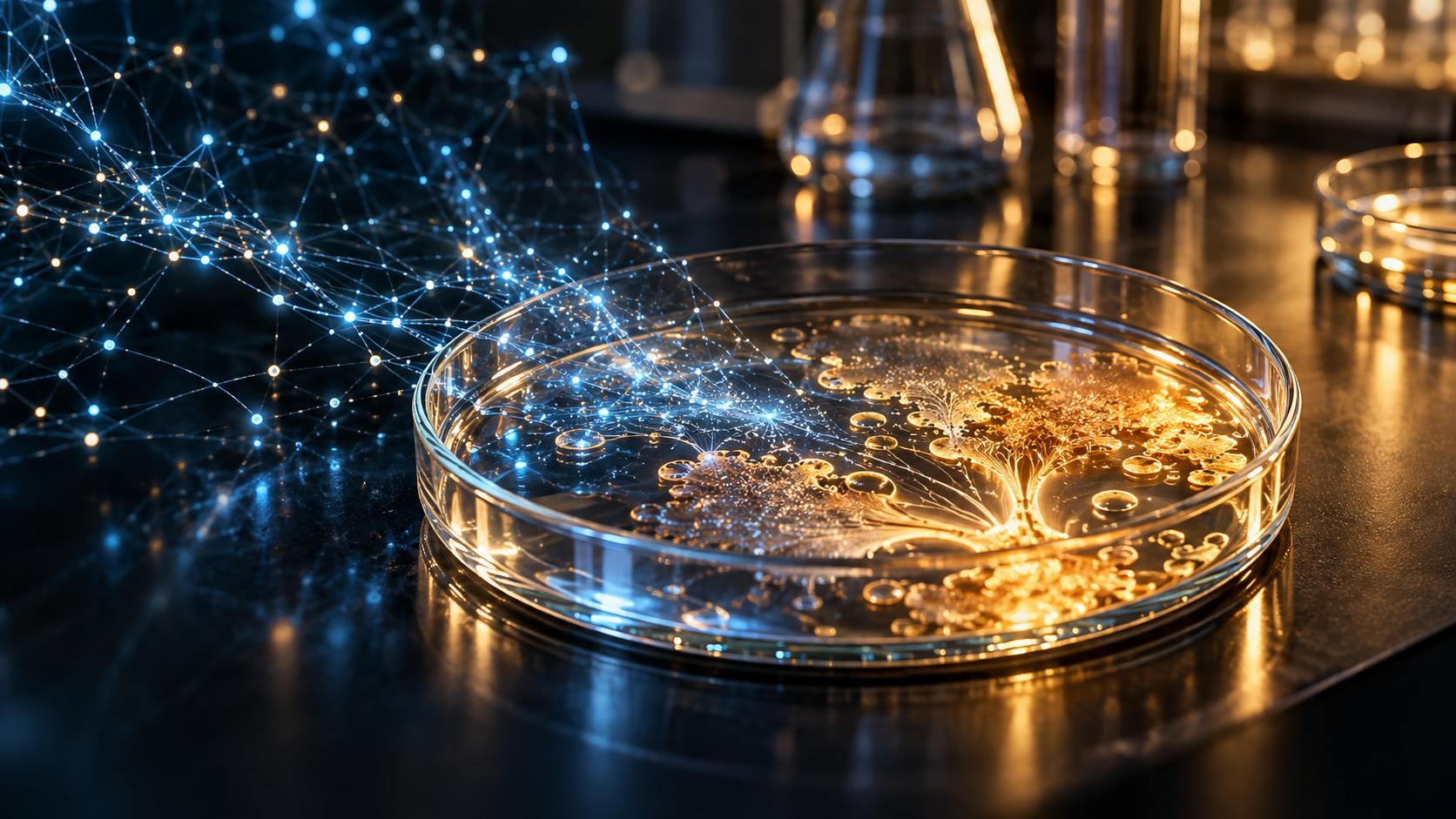
The meeting of artificial intelligence and the laboratory opens a larger conversation about discovery, human progress, and the power to decide what is worth pursuing.
What fascinates me most about technology is the moment a new capability begins to change the questions we can ask. Something that seemed out of reach yesterday becomes accessible enough for someone to try to understand it, test it, or build it. That is when I start thinking about what might follow.
This was my reaction to the news that an artificial intelligence company had established a biology laboratory. A physical laboratory, with samples, instruments, scientists, and experiments. A place where a computational proposal has to encounter matter and produce results that can be measured.
On September 23, 2026, Anthropic introduced its research team and announced early findings concerning an enzyme system that Claude helped identify in genetic data. The company makes clear that human scientists perform the laboratory work and that the system’s function remains under investigation. [1]
What interests me about this example is the connection it creates. An AI system participates in finding a hypothesis, scientists assess whether it deserves testing, and an experiment produces further evidence. That evidence can inform the next question. A wet lab is the setting for physical biological or chemical experiments, where research encounters what happens beyond the computer.
I see something here that matters to many more people than those working in technology or biology. If we can connect computational exploration more effectively with reliable experimentation, we may substantially expand what we are capable of investigating as a society.
Most people have encountered AI through answers, writing, images, and software. Its participation in scientific research invites us to consider it as part of a process that can produce new knowledge. It can help connect scattered findings, identify something unusual, and inform the choice of a next step. The value of that participation will depend on how useful it proves in practice.
Consider how many ideas remain unexplored because time, people, or money are insufficient. A research team has to keep choosing where to commit its limited resources. If certain stages become faster or less expensive, there may be room for approaches that previously could not fit into its plans.
This is a possibility I find deeply compelling: giving more opportunities to problems that receive too little attention. A rare disease, a difficult environmental application, or a material that requires extensive testing before its usefulness becomes clear. These are possibilities worth pursuing, while recognising that a faster search does not predetermine its outcome.
This direction already extends beyond biology. Berkeley’s A-Lab connects artificial intelligence and robotic equipment in the experimental synthesis of materials. [2] To me, the broader prospect lies in establishing more such connections between what we can calculate and what we can make, measure, and assess. That is where we might seek value for energy, production, and everyday life.
As the number of possible directions grows, however, choosing between them becomes more demanding. If we have thousands of plausible hypotheses, which deserve laboratory time? Which failure teaches us something useful? When should we persist, and when should we change course? An abundance of proposals may shift the difficulty from finding an idea to assessing what is worth testing.
This also shapes how I think about the human contribution. Scientists need judgment to distinguish an interesting signal from a misleading association, and experience to interpret an unexpected result. Access to more proposals increases that responsibility. Speed becomes valuable when accompanied by the ability to understand where it is taking us.
There is also a decision that comes before all of this: which problem we choose to solve. We could dramatically improve the efficiency of a research process and direct it towards goals of limited social importance. We could also give greater attention to needs that have struggled to find support for years. Technological capability leaves the question of purpose open.
This is where the darker side begins. The same deeper understanding of a biological system can be used with different intentions. When computational capability is connected to access to equipment and materials, decisions concern interventions in the physical world. I would want responsibility built into that connection, through clear boundaries, oversight of actions, and people who understand what they are authorising and why.
Risk also includes less spectacular possibilities. A mistaken hypothesis may acquire excessive authority because it originated from a powerful system. Pressure to deliver results quickly may weaken our willingness to challenge something promising. Automation needs to preserve room for doubt, repetition, and independent scrutiny. These are elements of an infrastructure I would trust.
There is also the question of concentrated power. An organisation with models, scientists, laboratories, and experimental data may be able to keep improving its own discovery process. Each cycle adds experience, even when the result is failure. My assessment is that this combination could create advantages that are difficult to acquire for someone whose access is limited to an application.
The next form of dependence could therefore concern the production of knowledge itself. Who will choose the research questions? Who will have access to results that are never published? Who will be able to repeat an experiment and challenge its conclusion? These capabilities will influence the room for action available to businesses, universities, and countries.
For Greece and Europe, I would frame this as a question of participation. What do we need to connect so that our researchers can formulate their own questions and investigate them? How do we support shared facilities, scientific collaborations, and access to reliable data? A society that wants to benefit from this change needs people and institutions with a practical capacity to conduct research.
Even success leaves a critical question unresolved: whom will it reach? If a discovery eventually leads to a treatment, who will be able to receive it? If a more efficient technology emerges, how will its benefits reach production and the public? An increase in our capabilities can coexist with considerable inequality in access.
For me, this is the real measure of progress. Knowledge needs people who can use it, production capacity that can turn it into a useful application, and conditions that allow it to reach those who need it. A promising laboratory finding is the beginning of a journey, with many further questions still to answer.
That journey matters when we speak publicly about AI. People understandably hear a scientific announcement through the lens of their own lives. Someone waiting for better treatment may hear hope. A young researcher may see an opportunity to pursue a question that once seemed too ambitious. A small business may imagine a material or process it could never have developed alone. These expectations deserve care. We should explain the opportunity clearly while making the distance between an early finding and a useful application equally clear.
I do not want this discussion to diminish our optimism. I am excited by the prospect of examining more ideas, understanding things that currently escape us, and giving difficult problems more opportunities to be solved. Precisely because I consider this capability significant, I want us to discuss it alongside the choices that will determine its direction.
When AI moves beyond the screen and enters the laboratory, we gain another way to test our ideas against reality. The greatest change may lie in the range of questions we dare to ask. What we choose to investigate, who can participate, and who ultimately benefits will reveal much about the kind of progress we want.
AI may expand what we are capable of doing.
What we choose to do with that power will reveal far more about us.
Πηγές / Sources
[1] Anthropic, September 23, 2026, Claude discovers a novel enzyme system with CRISPR-like repeats. Εταιρική ανακοίνωση πρώιμων ερευνητικών αποτελεσμάτων / Company announcement of early research findings.
[2] Lawrence Berkeley National Laboratory, April 17, 2023, Meet the Autonomous Lab of the Future.