Artificial Intelligence and the Future of Human Health: A New Era for Everyone?
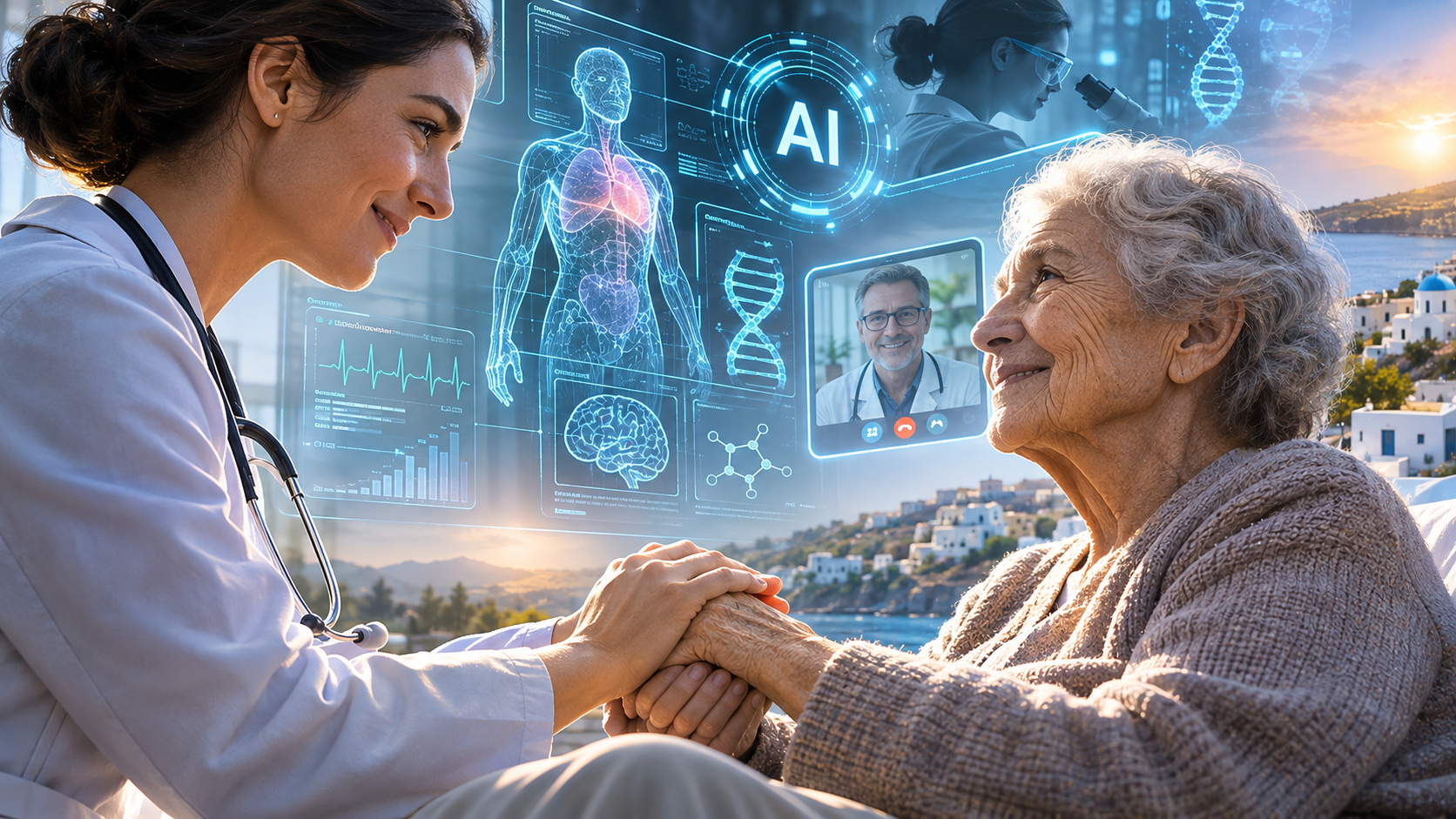
From today’s diagnostic capabilities to discoveries that could transform human life. And the fundamental question: can we turn scientific progress into better lives for everyone?
There are moments when a scientific announcement takes on greater significance for me than it initially appears to deserve.
Not necessarily because it introduces a technology we have never seen before, but because it gives us a reason to consider where its evolution might eventually lead.
That is what happened when I read Microsoft’s recent announcements about artificial intelligence in medical diagnosis and, a few days later, the World Health Organization’s announcement concerning the integration of AI into healthcare systems.
In the first case, an artificial intelligence system demonstrates impressive performance in solving complex diagnostic problems. In the second, 53 countries agree on a common framework for gradually introducing these technologies into healthcare.
Two different announcements that, when considered together, lead us to a question far greater than technology itself.
If we are indeed entering an era in which artificial intelligence could transform medicine, what will that mean for human life?
And more importantly, will this progress become a benefit shared by humanity, or will we continue living in a world where the best available medical capabilities remain a privilege reserved for those who can afford them?
This question matters deeply to me because it concerns more than treating diseases.
It concerns human well-being. Our ability to live healthier lives, experience less suffering, preserve our independence, and maintain our dignity.
Ultimately, it concerns the quality of human existence itself.
What Is Actually Changing with Artificial Intelligence?
We should begin with an important clarification.
Using technology to deliver healthcare services remotely is not new.
Telemedicine has existed for decades. Remote patient monitoring, the transmission of medical examinations for specialist assessment, virtual consultations, and collaboration among physicians in different locations are already established applications.
In many countries, these services have become part of everyday healthcare delivery. In others, including Greece, their development and adoption remain uneven despite various initiatives.
Therefore, the ability for a patient to communicate with a physician remotely is not what makes today’s developments revolutionary.
The difference lies in what can happen during that interaction.
Until now, technology has often served primarily as a means of transmitting information and connecting patients with healthcare professionals.
Artificial intelligence can introduce something fundamentally different: the ability to participate actively in interpreting medical information.
It can analyze data, identify complex relationships, support diagnostic reasoning, and draw upon enormous amounts of scientific knowledge.
And gradually, it may contribute not only to applying existing medical knowledge but also to creating new knowledge.
That is the essential distinction.
We are not simply developing better ways to access medicine.
We are approaching the possibility of transforming medicine itself.
A Microsoft Announcement and What It Actually Means
On October 22, 2026, Microsoft presented new results from its MAI Diagnostic Orchestrator, an artificial intelligence system designed to address complex medical diagnostic problems.
The system does more than answer questions based on information it receives.
It evaluates a case progressively, formulates possible diagnoses, identifies useful additional information and tests, and reassesses its conclusions as new evidence becomes available.
In Microsoft’s reported evaluation, diagnostic accuracy reached 83% in particularly complex cases drawn from the New England Journal of Medicine, compared with 22% for physicians working without external resources and 36% for physicians allowed to consult reference materials.
In a second evaluation involving more common cases based on emergency department data, the system achieved 80% accuracy compared with 47% for the participating physicians.
Microsoft also presented results suggesting that certain configurations could reduce the estimated cost of diagnostic testing.
These figures are impressive.
However, they do not mean that artificial intelligence is already better than physicians in everyday clinical practice. They reflect specific experimental evaluations, not definitive evidence of superiority under real-world conditions.
Independent assessment, clinical validation, and confirmation across different patient populations and healthcare environments remain essential.
But these qualifications do not diminish the significance of the development.
On the contrary, they help us recognize that artificial intelligence is beginning to assume a different role in medicine.
It is no longer limited to classifying information or identifying suspicious findings.
It is beginning to support increasingly complex processes of clinical reasoning.
And if this capability advances further, its consequences could be far more important than improvements in diagnostic accuracy alone.
Behind Every Diagnosis, There Is a Human Being
When we read that a system achieved 80% diagnostic accuracy instead of 47%, it is easy to focus on the difference between the numbers.
But medicine is not a competition between performance scores.
Behind every diagnosis is a human being.
Someone experiencing pain without knowing what it means.
Someone waiting for test results, afraid of what they might reveal.
A parent worried about their child.
An elderly person trying to preserve their independence.
Someone who has already visited several physicians, undergone repeated examinations, and still does not know what is happening to them.
For these people, the value of a better diagnosis cannot be fully expressed as a percentage.
It may mean fewer days of anxiety.
Fewer unnecessary medical examinations.
Timely treatment before an illness has the opportunity to progress.
It may mean that someone can continue living their life without enduring a medical ordeal that could have been prevented.
And in certain circumstances, it may mean the difference between life and death.
That is why I believe we need to change how we discuss these developments.
What interests me most is not whether a machine can outperform a doctor.
It is how many more people could benefit if their physician had access to such capabilities.
And how we can ensure that these capabilities are not restricted to those who can afford them.
From Diagnosis to Prevention — and Beyond
The real potential, however, extends far beyond diagnosis.
If we look a little further ahead, we may realize that we are currently discussing only a small part of what might eventually become possible.
Medicine is built upon an extraordinary body of knowledge about the human organism.
And yet, countless questions remain unanswered.
Why do some people develop particular diseases while others with similar risk factors do not?
Why do two patients with the same diagnosis respond so differently to the same treatment?
Why do certain forms of cancer remain exceptionally difficult to treat?
Why do we age in the way we do?
How exactly do the immune system, nervous system, metabolism, and the billions of microorganisms living within us interact?
And how much do we still not know about the fundamental processes of human life?
Artificial intelligence may offer new ways to approach these questions.
Not merely because it can process more information.
But because it can explore enormous numbers of combinations, identify relationships between different biological phenomena, and propose research hypotheses that can subsequently be tested experimentally.
Consider what this could mean for discovering new therapeutic targets, developing medicines, advancing personalized medicine, and understanding complex diseases.
It could lead to more effective treatments.
It could help us recognize certain diseases before serious symptoms develop.
Perhaps it will allow us to understand biological mechanisms that we currently comprehend only in fragments.
But what I find truly fascinating lies even further ahead.
What If AI Discovers What We Do Not Yet Know to Look For?
In my previous article, I explored the possibility that artificial intelligence may eventually make scientific discoveries beyond the current limits of human understanding.
Not simply answering difficult questions, but identifying entirely new scientific directions — perhaps even questions humanity has never imagined asking.
If that possibility is significant for mathematics and physics, imagine what it could mean for biology and medicine.
We ask questions based on what we already know.
We search for treatments for diseases we have identified.
We investigate biological mechanisms we have managed to recognize.
We attempt to modify processes we understand to influence human health.
But what about the mechanisms whose existence we have not yet discovered?
What about relationships between biological processes we have never thought to connect?
What about possibilities for influencing the human organism that we cannot even describe today because we lack the scientific concepts needed to recognize them?
Imagine an artificial intelligence system capable of combining new discoveries in molecular biology, genetics, chemistry, physics, and materials science.
One discovery leads to another.
The second creates possibilities for a third.
And new combinations of these findings open research directions that previously could not even have been formulated.
We do not know what might emerge.
And perhaps that is the most important point.
The greatest future breakthroughs in human health may not emerge from the treatments we are currently trying to develop, but from possibilities whose existence we have not yet discovered.
This is not a promise that we will cure every disease or eliminate aging.
It is a recognition that we may be approaching a fundamentally different era of scientific discovery.
An era in which artificial intelligence does not merely help us solve familiar medical problems but may contribute to identifying entirely new possibilities for human life.
Perhaps the Greatest Transformation Will Concern the Meaning of Health Itself
For much of human history, medicine focused primarily on treating disease.
Over time, we developed increasingly powerful capabilities in prevention, vaccination, early diagnosis, and health monitoring.
Now we may be approaching an even deeper transformation.
Not simply treating diseases more effectively.
But understanding more profoundly the processes that keep the human organism healthy.
Consider what it means for someone to live into their eighties or nineties.
It is not enough to ask how many years they lived.
How many of those years could they move without serious limitations?
For how long could they maintain their memory, reasoning, and independence?
How many years could they continue creating, traveling, enjoying relationships, and participating actively in society?
This is the distinction between longevity and well-being.
The first concerns the duration of life.
The second concerns its quality.
And if we truly want to understand what artificial intelligence could mean for humanity, I believe we must give far greater attention to the second.
What would it mean to substantially reduce the years people spend living with serious illnesses?
What would it mean to address certain forms of dementia earlier or reduce complications associated with chronic conditions?
What would it mean for someone to preserve their physical and cognitive independence for many more years?
We are not merely talking about additional years of life.
We are talking about more years of life truly lived.
And that may be one of the most important human benefits future scientific progress could deliver.
Will Humanity as a Whole Be Able to Benefit?
But this brings us to the second major question.
And it is just as important as the first.
Suppose that over the coming decades, artificial intelligence contributes to the discovery of an extraordinarily effective treatment for a serious disease.
Or that new preventive approaches allow millions of people to avoid major health problems.
Or that early diagnosis becomes so effective that certain diseases can be treated long before they reach dangerous stages.
Who will have access?
Those who can afford it?
Citizens of particular developed countries?
People covered by specific healthcare or insurance systems?
Or will we manage to create the conditions for these capabilities to reach a much greater share of humanity?
Medical history offers many examples of advances that took years or decades to become widely available.
This is not always the result of a deliberate intention to exclude people.
Treatments require research, clinical trials, manufacturing, equipment, healthcare professionals, and financing.
Developing a new treatment and making it available to millions of people are two different challenges.
But that distinction should not become an excuse for treating inequality as inevitable.
On the contrary, it gives us a reason to think now about how access to future medical capabilities should be organized.
And artificial intelligence may offer an additional opportunity.
Certain digital services can be delivered at considerable scale with a lower incremental cost per user than traditional approaches.
This does not apply equally to every medical application, and it certainly does not eliminate the costs of hospitals, diagnostic tests, medicines, or healthcare professionals.
But it could change some of the economic conditions governing access.
The question is whether we will choose to take advantage of that possibility.
From Technological Announcements to Social Responsibility
On October 29, 2026, the World Health Organization announced that all 53 countries in its European Region had adopted a shared roadmap for artificial intelligence in healthcare for the period 2026–2033.
The initiative addresses safe implementation, appropriate infrastructure, professional training, and equitable access.
It represents an important development, not because it automatically resolves existing problems, but because it recognizes that technology alone is insufficient.
Telemedicine itself provides an excellent example.
The technological capabilities have existed for years.
Yet their practical implementation continues to vary considerably between countries and regions.
This teaches us something essential.
The availability of a technology is not the same as the availability of the services it could provide.
And there is no reason to believe artificial intelligence will be an exception unless we consciously address the question of access.
We need public healthcare systems capable of adopting reliable technologies.
We need partnerships between scientific institutions, private companies, and public organizations.
We need economic models that support broad access to effective services.
And we need measurable outcomes that go beyond technical performance to examine whether people’s health and quality of life have genuinely improved.
I do not believe public and private initiatives must necessarily be in opposition.
Developing new medical technologies requires investment, entrepreneurship, and specialized research.
But human health cannot be evaluated exclusively according to the criteria of a commercial market.
A person’s need for treatment does not diminish simply because they cannot afford it.
And What About the Doctor?
When discussing artificial intelligence in healthcare, it is easy to arrive at the question of whether machines will eventually replace physicians.
I do not consider that the most interesting dimension of the discussion.
Medicine is not merely the scientific identification of a problem.
It is also the human relationship surrounding that problem.
A person receiving a difficult diagnosis needs more than the name of their disease.
They need to understand what it means for their life.
They need someone to explain their options.
To listen.
To help them navigate uncertainty, fear, and the consequences of the decisions they must make.
Perhaps artificial intelligence will allow us to strengthen that relationship.
If physicians have access to better diagnostic support, can evaluate complex information more efficiently, and are relieved of part of their administrative workload, they may gain more time for the person sitting in front of them.
This will not necessarily happen.
It will depend on how we organize healthcare services.
But it is a possibility worth pursuing.
Because progress should not lead us toward medicine that is technically more advanced but humanly impoverished.
Instead, it could allow us to combine better scientific care with greater human presence.
A New Reality for Human Life?
In my previous article, I asked whether artificial intelligence might eventually lead us to discoveries that exceed even humanity’s collective capacity for understanding.
Whether it could recognize scientific realities whose existence we do not yet suspect.
And whether those discoveries, combined with one another, could give rise to a world unlike anything we are currently capable of imagining.
That thought becomes especially significant when applied to human health.
Because we are not merely talking about new machines, better materials, or faster computers.
We are talking about our own lives.
About how we are born, how we grow, and how we age.
About the diseases we can treat.
About the capabilities of our bodies and minds.
About the time available to us and the quality with which we experience it.
We do not know what discoveries lie ahead.
We do not know whether some of medicine’s greatest challenges will ultimately prove solvable.
And we certainly cannot present future possibilities as established achievements.
But we can now seriously consider the possibility that artificial intelligence will contribute to a form of scientific exploration fundamentally different from what we have known.
One in which discoveries may fuel further discoveries, generating possibilities that are not even part of our current scientific imagination.
And if that happens, the medicine of the future may look nothing like the medicine we know today.
Perhaps even our understanding of what human health means will change.
The Greatest Achievement Will Not Be Scientific Alone
I would like to close with a thought I consider more important than any technological prediction.
Suppose artificial intelligence contributes to a truly extraordinary discovery.
A treatment that addresses a disease previously considered incurable.
A method that prevents serious medical conditions before they develop.
A new understanding of aging that allows people to preserve their health and independence for many more years.
That would undoubtedly be an extraordinary scientific achievement.
But its true value to humanity would also depend on something else.
Whether someone living in a remote community could benefit from it.
Whether a family with limited income could access it.
Whether a public healthcare system could offer it to its citizens.
Whether scientific progress could translate into more years of healthy life for many, rather than only a privileged few.
Perhaps, in the future, we will overcome medical limitations that today appear insurmountable.
Perhaps we will discover possibilities for human life whose existence we never suspected.
Perhaps we will find ourselves facing a reality profoundly different from the one we know.
But if that progress cannot reach people, we will have achieved an extraordinary scientific breakthrough without fully realizing its potential to change the world.
The real challenge is not simply whether artificial intelligence can offer us a better life.
It is whether we can create the conditions that make that better life possible for everyone.
Because the greatest achievement of a technological revolution will not necessarily be its most spectacular discovery.
Perhaps it will be the moment humanity succeeds in transforming its capabilities into better health, less suffering, and greater dignity for as many people as possible.
And if we achieve that, we will not merely have transformed medicine.
We will have transformed human life itself.
Sources & Further Reading
1. Microsoft — Building Medical Superintelligence
October 22, 2026
The experimental results and limitations of the diagnostic evaluation of MAI-DxO.
Read the official announcement
2. World Health Organization (WHO) — Consolidated Telemedicine Implementation Guide
2022
Telemedicine as an already established field of digital healthcare.
Read the publication
3. World Health Organization (WHO) — Roadmap for AI in Health 2026–2033
October 29, 2026
The shared direction adopted by 53 countries for the safe and equitable use of artificial intelligence in healthcare.
Read the official announcement
4. World Health Organization (WHO) — Healthy Ageing and AI in Health
October 30, 2026
The connection between artificial intelligence and healthy ageing.
Read the official announcement