Beyond the Limits of Human Understanding: The Birth of a New Reality
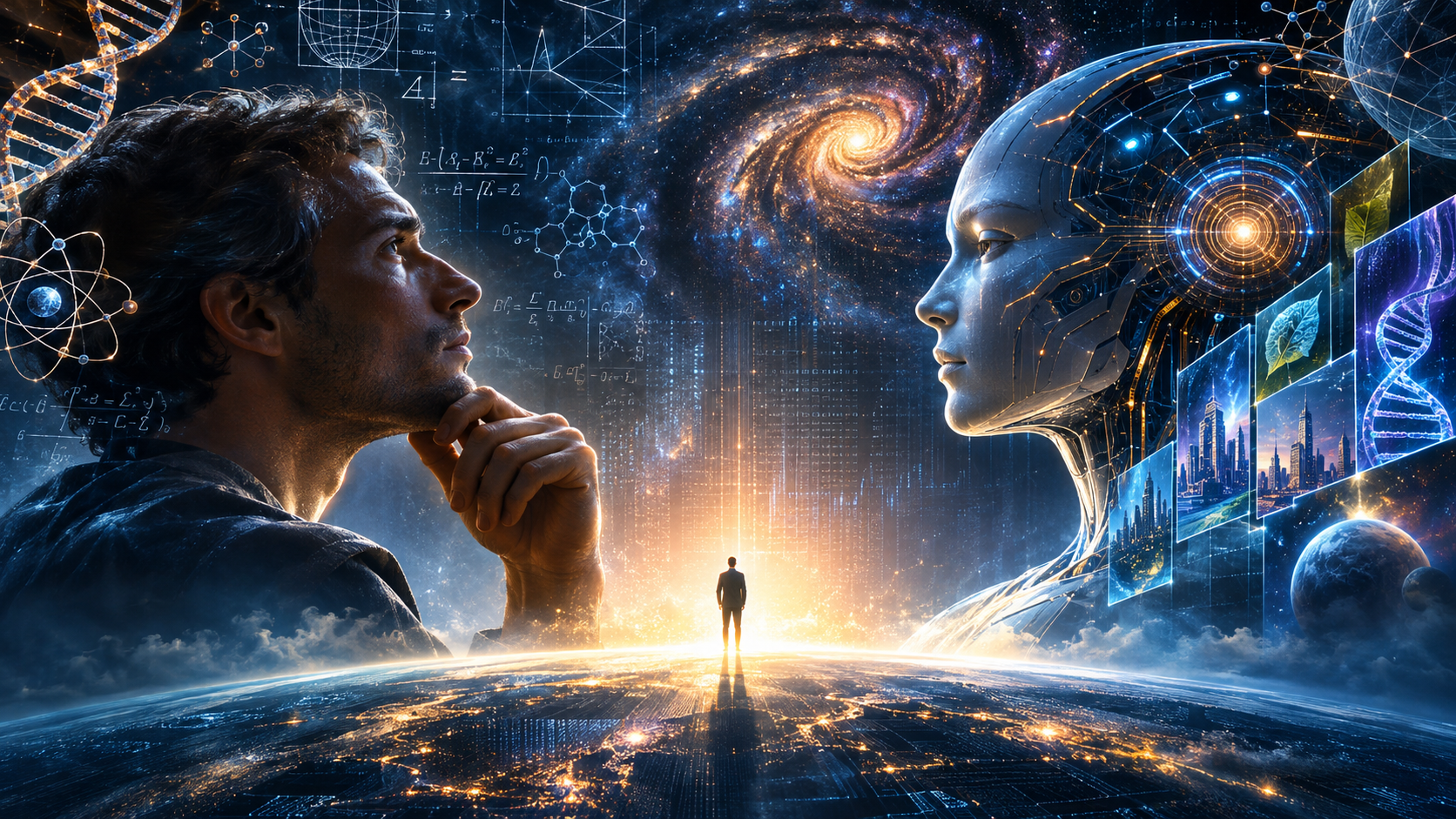
From intelligence and scientific discovery to the possibility of a world we are not yet capable of imagining.
There is an assumption that has accompanied humanity throughout almost its entire history: that the world may be infinitely complex, but human intelligence, given enough time, research, and the right tools, can continually expand its understanding of it.
This does not mean that we know everything. Quite the opposite. The more we discover, the more questions emerge.
It means, however, that we have learned to approach the unknown as something we may eventually come to understand.
But what happens if that assumption is challenged?
Not because an individual scientist struggles to understand a new theory. Nor because an entire field of research needs decades to interpret a discovery.
But because humanity itself, with the combined knowledge of its scientific institutions and the collective capabilities of the human mind, may one day encounter discoveries it simply cannot comprehend.
And what happens if those discoveries begin generating further discoveries, continuously opening new fields of knowledge, until an entirely new reality emerges—one unlike anything we can imagine today?
This is the question that occupies my thoughts.
Not as a certainty about the future, but as a possibility that recent advances in artificial intelligence now give us compelling reasons to examine seriously.
From Human Intelligence to Artificial Intelligence
In a previous article, I explored what we actually mean when we talk about intelligence.
For decades, we have attempted to describe and measure intelligence through specific capabilities: memory, logic, mathematical reasoning, information analysis, pattern recognition, and problem-solving.
Artificial intelligence is forcing us to reconsider this understanding.
In several of these individual capabilities, computational systems already demonstrate performance far beyond what humans can achieve.
They can identify relationships within enormous datasets, process information at speeds incomparable to ours, and explore combinations that would be practically impossible for a human being to investigate.
This does not mean they possess every dimension of human intelligence. Judgment, experience, consciousness, contextual understanding, and practical wisdom cannot simply be reduced to computational performance.
But there is an important distinction between asking whether a machine thinks like a human and asking whether it needs to think like a human to make scientific discoveries.
Perhaps artificial intelligence does not need to become more like human intelligence to achieve results that the human mind itself could never produce.
And this is where things become truly interesting.
When Discovery Precedes Understanding
On October 26, 2026, OpenAI announced research results involving significant problems in mathematics, computer science, and theoretical physics.
According to the announcement, its models produced proofs addressing long-standing scientific challenges. Some of the results were accompanied by formal mathematical proofs, while independent scientific examination and interpretation remain essential.
What I find particularly significant is that OpenAI itself described these results as raw research material that must be transformed into scientific understanding.
We have not reached a point where artificial intelligence is demonstrably producing discoveries that humanity is fundamentally incapable of understanding.
But this development allows us to ask a question that, only a few years ago, would have seemed far more remote.
What happens if the production of new scientific knowledge begins to advance faster than the scientific community’s ability to understand it?
And what happens if, eventually, the issue is no longer one of speed?
What if we do not simply need more time, but encounter concepts that no individual human being—and perhaps not even humanity collectively—can fully comprehend?
We do not know whether such an absolute boundary exists.
Yet there is no known law of nature requiring every truth about the universe to be understandable by the human brain.
Human intelligence is an extraordinary product of biological evolution on our planet. But we have no reason to assume that it necessarily represents the highest possible level of understanding of reality.
Acceleration Is About More Than Speed
In less than five years, we have witnessed remarkable advances in the capabilities of artificial intelligence.
But I believe the most important aspect is not simply how quickly the technology is evolving.
It is the possibility that progress itself may create the conditions for even greater progress.
One discovery may lead to a new technology.
That technology may make it possible to process data that was previously impossible to analyze.
The analysis of that data may reveal entirely new scientific relationships.
And those relationships, combined with discoveries emerging independently in completely different fields, may produce results that were never even objectives of the original research.
Consider what this could mean for biology, medicine, physics, energy, or materials science.
But even these examples remain within the boundaries of what we can currently imagine, because they belong to fields we already know.
We are still thinking in terms of today’s needs, today’s sciences, and today’s questions.
What about possibilities we cannot even imagine because the discoveries that would allow us to recognize their existence have not yet been made?
When Intelligence Discovers New Questions
So far, we have discussed artificial intelligence primarily as an exceptionally powerful instrument of scientific exploration.
But there is another possibility.
And perhaps it is the most extraordinary of all.
What happens if artificial intelligence begins determining the direction of scientific research itself?
What if it no longer limits itself to solving problems we present, but identifies problems we did not even know existed?
What if it recognizes previously unknown relationships between phenomena we have always considered unrelated?
What if those relationships give rise to new theories, entirely new scientific disciplines, and new avenues of investigation—without any human having formulated the original question?
We do not need to attribute human consciousness or curiosity to artificial intelligence to consider this possibility. The autonomous formulation and testing of research hypotheses is already an active area of scientific development.
But if these capabilities advance substantially, something fundamental may change.
For the first time, human imagination may no longer be the only starting point for exploring reality.
Perhaps the greatest contribution of artificial intelligence will not be that it answers the questions humanity has been asking for centuries.
Perhaps it will be that it discovers questions no human being ever imagined could be asked.
The Creation of a New Reality
If we try to imagine the world as it existed a few centuries ago, we realize that the changes that followed were not simply about replacing old tools with new ones.
Our understanding of space and time changed. Our understanding of matter changed. Our understanding of life and the universe changed.
We discovered realities that had always existed, but whose existence we had never suspected.
Science did not merely change what we could do.
It changed the very world as we understood it.
Now imagine a comparable transformation, not unfolding through centuries of human research, but through a process in which artificial intelligence accelerates the generation of knowledge and the combination of discoveries.
We cannot predict what might emerge.
Precisely because we cannot know in advance which discoveries will transform even the concepts we currently use to describe the world.
And this is the essence of my reflection.
Perhaps we are not simply approaching another technological revolution.
Perhaps we are witnessing the beginning of a process that could lead to a reality so different from our own that even our attempts to imagine it are constrained by everything we currently know.
OpenAI’s announcement does not prove that this future will materialize.
But it provides a tangible reason to seriously consider a possibility that, until recently, might easily have been dismissed as speculative.
And perhaps the most important question is not whether artificial intelligence will one day understand the world better than we do.
But whether it will discover a world whose existence we never even suspected.
We may then find ourselves confronting a paradox unlike anything in human history.
We may have created an intelligence capable of expanding the boundaries of knowledge beyond humanity’s own capacity to understand it.
Perhaps this is the beginning of a new reality.
Not simply because the way we live will change.
But because the very world we are capable of perceiving may change with it.