Unemployed Humans, Unemployed AI
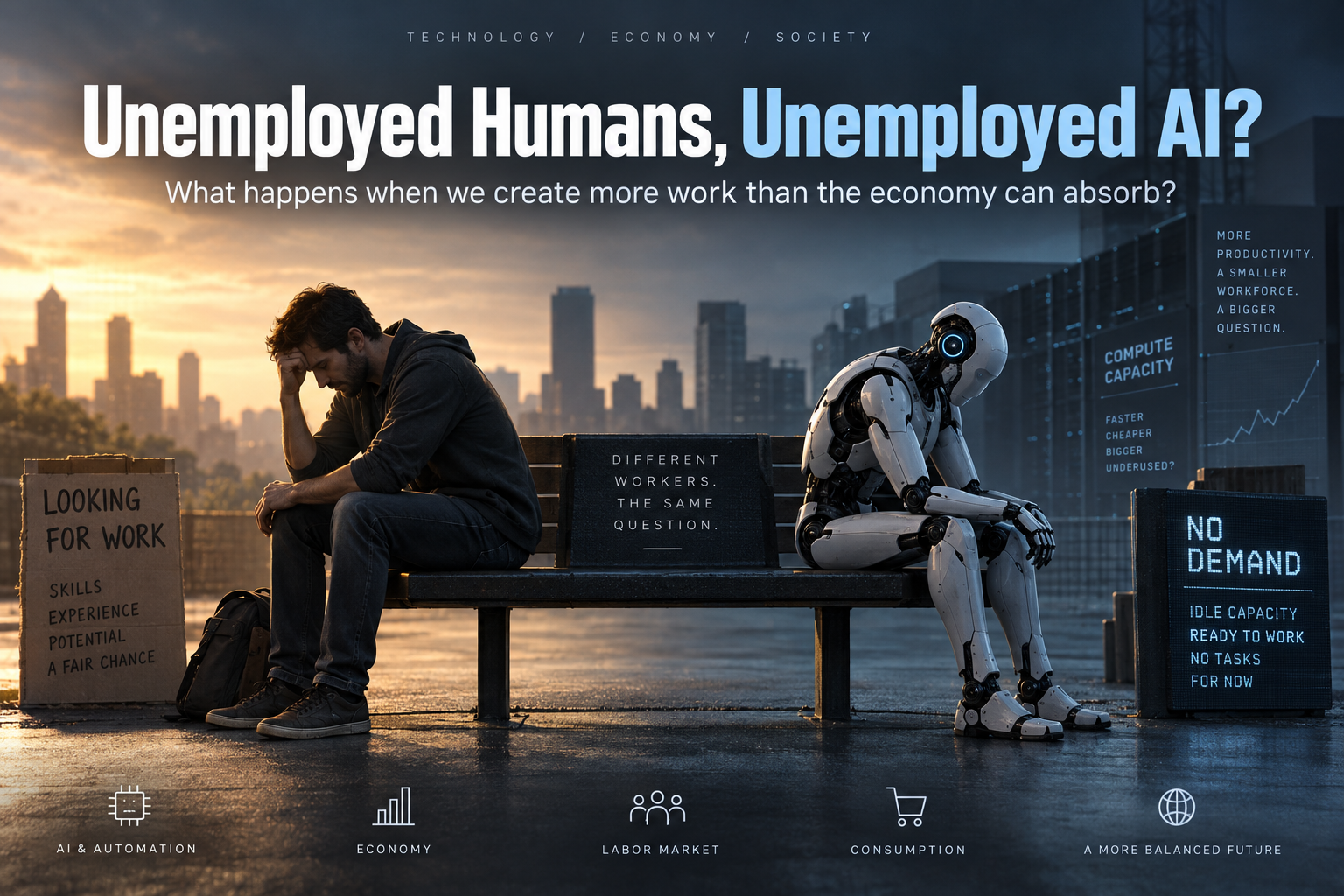
What happens when we create more work capacity than the economy can absorb?
For years, the conversation around Artificial Intelligence has revolved around a question we have all heard, in one form or another:
Will AI take our jobs?
It is a perfectly reasonable question. As we watch models write code, analyze data, draft documents, support customers, and gradually gain the ability to execute entire sequences of actions as agents, it is natural to wonder how many of today’s jobs will still require humans.
Lately, though, I have started to think that this may only be half of the question.
What triggered that thought was an analysis by Epoch AI on the amount of computational capacity expected to become available over the next few years. According to its estimates, the hardware shipped by 2027 could, under specific technical assumptions, support around 30 to 170 million frontier AI agents running at the same time.
If we translate that into working hours, bearing in mind that an agent does not operate on an eight-hour human workday, the potential productive capacity is roughly equivalent to 140 to 720 million full-time workers.
We need to be careful here. This does not mean that 720 million digital workers will suddenly appear in 2027. Nor does an AI agent become equivalent to a human simply because it can operate for the same number of hours. The study itself does not make that claim.
What it does show, however, is something different and, in my view, far more interesting: we may be approaching a point where available digital productive capacity grows much faster than the real economy’s ability to make use of it.
Epoch AI even offers an illustrative calculation. Using only 20% of that potential 2027 capacity would require, at today’s API-equivalent prices, annual demand in the range of $2.6 to $5.3 trillion.
Whether the final number is somewhat lower or higher is not really the point. What matters is the question hiding behind it:
What happens if we become capable of creating much more work than we actually need?
We are used to thinking about the opposite problem
For most of economic history, the problem has been scarcity.
Not enough people. Not enough working hours. Not enough specialists. Not enough engineers, doctors, developers, accountants, analysts.
We built tools and machines precisely to allow the same person to produce more.
And every major technological shift followed a similar logic. Agricultural equipment increased the output of a farmer. Industrial machines increased the output of a factory worker. Computers increased the productivity of accountants, engineers, analysts and software developers.
AI starts from the same point, but it may eventually go one step further.
It does not simply increase the productivity of a human worker. It can gradually create productive capacity that does not require one human being behind every unit of work.
A developer using AI can do more. A smaller team can support more projects. Some parts of a workflow can already be carried out almost autonomously by agents.
For an individual company, all of this looks extremely attractive. If I can do with sixty people and AI what I used to do with one hundred people, I have lower costs, higher productivity and probably better margins.
Up to this point, the economics seems obvious.
The question begins when we move away from the individual company and look at the economy as a whole.
Something is already changing in the labor market
For some time now, I have been receiving the same message, particularly from people in markets outside Greece: developer roles are no longer as easy to find as they once were.
That alone, of course, is not proof of a major structural shift. Labor markets are cyclical. Companies hire and cut staff for many reasons, and we should not ignore the over-hiring that took place in earlier years.
Still, the data is beginning to show a change worth watching.
According to Indeed Hiring Lab, software development job postings in the United States have recovered from their lows, but that recovery has been disproportionately concentrated in senior roles. Between May 2025 and May 2026, 71% of the increase in software development postings came from senior positions.
The picture becomes even clearer when we look at the composition of the market. In early 2026, close to seven in ten software development postings were for senior roles, while entry-level positions represented only a very small share.
That is not enough to say that “AI is eliminating juniors.” That would be too simplistic and probably wrong.
What we can say is that companies increasingly seem to value an already experienced employee who can multiply his or her productivity with AI more than a junior who still needs years to build that experience.
And that creates another problem, one I have written about before: if we gradually remove from juniors the very tasks through which they learn, at some point we will have to answer a difficult question.
Where exactly will the next generation of seniors come from?
This time, however, I want to push the thought a little further.
Because what happens to the worker does not stop with the worker.
An experience we have already lived through in Greece
When I read the Epoch AI estimates, I immediately thought about the Greek economic crisis.
Not because I believe the two situations are the same. They are not.
The Greek crisis had very specific fiscal, financial and structural causes. It did not begin because wages were cut or benefits were removed. Those cuts were part of what followed the crisis, not its original cause.
But there was a mechanism that those of us who lived through that period saw very clearly in the real economy.
When disposable income fell for a large part of the population, consumption fell with it.
Between 2010 and 2013, average gross earnings in Greece declined cumulatively by 18.9%, employment by 20.8%, and total compensation of employees by 34.9%. The purchasing power of average gross earnings fell by 25.2%. The Bank of Greece itself noted the severe impact this had on consumer demand.
For me, though, the most revealing part was not the number itself.
It was what you could see around you.
When a public-sector employee lost a significant part of his income or a benefit disappeared, the impact did not stop at that household’s budget. That person was also a customer at the local restaurant, the clothing shop, the garage, the travel agency, the hotel, the independent professional.
When that person cut spending, someone else lost revenue.
And that person, in turn, reduced purchases, delayed investment, or cut staff.
So the loss of one person’s income gradually became another person’s loss of turnover.
That is why I see an interesting parallel with today’s discussion about AI. Not in terms of what starts the problem, but in terms of how an income shock can spread throughout an economy.
A worker is not only a cost
When a company looks at payroll, an employee is understandably a cost.
But when we look at the economy as a whole, that same person is also a customer.
The salary paid by one company does not disappear. It becomes rent, groceries, a car payment, holidays, restaurants, subscriptions, services, education. In other words, it becomes revenue for someone else.
So let us assume that AI allows one company to reduce its need for human labor by 30%.
For that particular company, this may be an excellent decision.
But what happens if something similar takes place almost simultaneously in software, accounting, marketing, customer support, legal services, analytics, design and administration?
The workers no longer needed in all these functions do not disappear. If enough new and well-paid jobs are not created, part of the income that used to flow back into the economy through consumption disappears with them.
At that point, the discussion stops being only about jobs.
It becomes a discussion about demand.
And what if people cannot buy what we produce?
This is the part I find most interesting and, I admit, somewhat unsettling.
If AI dramatically increases productivity, we will be able to produce more software, more services, more analysis, more content and probably many things we cannot yet imagine.
But that does not automatically mean there will be equal demand for all of it.
For a market to exist, someone must be able to buy the product.
And here there is a fundamental difference between a human worker and an AI agent.
A human being who works also consumes. That person gets paid, and a large part of that income flows back into the economy.
An AI agent can produce without becoming a consumer in the human sense.
It does not need a house. It does not buy food. It does not go on holiday. It does not buy a car. It does not eat in restaurants. It does not pay for its children’s education.
And that creates a question that may sound almost naive, but I think it hides a serious economic problem:
What will 700 million AI workers buy?
Nothing.
Their owners, of course, may earn income from their work. But that is very different from distributing income across hundreds of millions of people who then spend it across millions of businesses.
If the transition toward AI therefore results in a significant shift of income from labor toward capital, we no longer have only a technological issue. We may have a problem of how purchasing power is distributed.
And that detail could prove decisive.
Unemployed humans and “unemployed” AI
Now let us take the thought one step further, without pretending that we can predict the future.
If enough people lose work or income, consumption may fall. If consumption falls, business revenues fall. If revenues fall, companies need less production, less marketing, less software, less analysis, less logistics and fewer services overall.
And somewhere in that chain, something genuinely strange can happen.
We could have people looking for work at the same time that we have enormous amounts of AI productive capacity for which there is also not enough economically useful work.
When I say “unemployed AI,” I obviously do not mean unemployment in the human or social sense. An agent does not experience unemployment and does not need unemployment benefits.
I am talking about idle productive capacity.
Chips that exist but are not fully utilized. Models capable of carrying out millions of tasks for which there are not enough tasks someone is willing to pay for. Data centers and agents capable of producing far more than the real economy actually demands.
And if something like this were to happen, we would reach a situation that only seems paradoxical at first glance: human unemployment could itself contribute to underutilization of AI.
As human income falls, demand falls. As demand falls, the amount of economically useful work available to machines can fall as well.
A productivity boom could, if the transition happened too quickly and without other balancing mechanisms, begin to shrink its own market.
Productivity is not the same thing as prosperity
This is, I think, one of the points we often overlook when talking about AI.
We hear that Artificial Intelligence will dramatically increase productivity, and we tend to treat that almost as a synonym for greater prosperity.
It is not quite the same thing.
Productivity tells us how much we can produce with the resources we have. It does not tell us how the income generated by that production is distributed.
If one person using AI can produce what five people used to produce, there is an obvious economic gain.
But there is also another question: what happened to the income of the other four?
If they moved into new, perhaps better and more productive jobs, then we have an extremely positive technological transition.
If they did not, total output could rise at the same time that the purchasing power of a large part of society declines.
We do not know which version will dominate.
History has shown us repeatedly that technology creates new jobs and new markets that were impossible to predict in advance. There is no serious reason to assume that this time will necessarily be different.
But there is also no reason to assume that the adjustment will be automatic, immediate and painless.
Especially because the speed of the current change is unusual.
Perhaps the scarce resource will ultimately be demand
We are currently spending enormous amounts of money on GPUs, data centers, energy and new infrastructure because we believe computational intelligence will become one of the most valuable resources in the next economy.
We are probably right.
But the Epoch AI analysis made me look at the same issue from the opposite direction.
What if we become too successful?
What if we really do create tens or hundreds of millions of digital-work equivalents?
What if the ability to produce knowledge, software, services and decisions becomes so cheap and so abundant that it is no longer the bottleneck in the economy?
We may then discover that the difficult part was not producing.
It was maintaining enough income, enough consumption and enough real demand for someone to have a reason to pay for everything we can now produce.
That is why I do not think the most interesting question is whether AI will take our jobs.
The more important question is what happens to the economy if work itself, human and digital together, stops being scarce.
The answer may be an age of extraordinary prosperity. We may work less, produce more and gain access to goods and services that today remain expensive.
But for that to happen, the gains from productivity must somehow return to the economy as income and demand.
Otherwise, there is a possibility that would have sounded almost absurd only a few years ago:
people without enough work, and machines with more capacity to work than we actually need.
And if we ever reach that point, we may discover something surprisingly simple.
Being able to produce almost everything does not mean very much if there is no one who can afford to buy it.